Showing posts with label Philadelphia Phillies. Show all posts

Thursday, January 16, 2025

Bob Uecker Brought Smiles to Countless Faces

Bob Uecker passed away earlier today, just 10 days before his 91st birthday. Uecker hit just .200 during his six year MLB career, but he made it to the Baseball Hall of Fame, winning the Ford Frick Award in 2003 as recognition for an outstanding broadcasting career that lasted from 1971-2024. Uecker is widely known for his self-deprecating humor, but his witty quips should not obscure the reality that he was an outstanding play by play announcer who made that job look much easier than it is. Retired players who become broadcasters usually are analysts/color commentators, not play by play announcers. Broadcaster Brian Anderson told MLB Network that Vin Scully was the greatest baseball broadcaster of all-time "hands down" and that Uecker is number two on that distinguished list. Uecker won a trophy case full of honors as a broadcaster, including being selected five times as the Wisconsin Sportscaster of the Year (1977, 1979, 1981, 1982, 1987). He was inducted in the National Sportscasters and Sportswriters Association's Hall of Fame in 2011, and he was inducted in the National Radio Hall of Fame in 2001. MLB.com's Adam McCalvary wrote a wonderful tribute to Uecker, complete with highlights of some of Uecker's funniest moments.

Uecker earned the rank of corporal in the U.S. Army before signing a contract with his hometown Milwaukee Braves in 1956. He made his MLB debut with the Braves in 1962, and during his pro career he played for the Braves (in both Milwaukee and Atlanta), the St. Louis Cardinals, and the Philadelphia Phillies. He was a member of St. Louis' 1964 World Series championship team, though he did not play in the World Series. 

After his playing career ended, Uecker became a broadcaster in Atlanta before beginning his 53 year run as a Braves' broadcaster. Much like some coaches have a coaching tree of people who they mentored who then became successful coaches, Uecker had a broadcasting tree of people who he mentored who later became the primary broadcaster for various MLB teams; that tree includes Joe Block, Pat Hughes, Jim Powell, and Cory Provus. In addition to his local broadcasting duties in Milwaukee, Uecker also did national MLB broadcasts for ABC and NBC. Although he called games straight for the most part, he became known for his funny remarks. Uecker's brilliant comedic touch earned him numerous appearances on Johnny Carson's "Tonight Show," plus a starring role in the TV series "Mr. Belvedere."

I am too young to remember Uecker's MLB playing career, and I never heard his local Milwaukee broadcasts, but I remember his national TV work and I regularly watched "Mr. Belvedere," which aired from 1985-90. Some of my earliest and most vivid memories of Uecker are his hilarious series of Miller Lite TV commercials, perhaps the most famous of which revolved around the premise that Uecker assumed that his seat "must be in the front row" when in reality the usher escorted him to a seat near the top of the stadium; from that perch, Uecker confidently exclaimed "He missed the tag!" to an umpire that he could barely see. In the "Major League" movie trilogy, Uecker played broadcaster Harry Doyle, who delivered a line that became the 20th century version of a meme: "Juuuust a bit outside" (describing a pitch that was much more than just a bit outside).

Uecker brought a lot of joy to a lot of people. The phrase "American Original" is perhaps overused, but Uecker fits that description quite well; he accomplished a lot without taking himself too seriously.

Monday, December 9, 2024

Dick Allen and Dave Parker Receive Long-Overdue Hall of Fame Recognition

A toxic combination of PED cheating destroying MLB's once-hallowed record book and "stat gurus" preaching "analytics" above all else (while cheating to win World Series titles because, apparently, the "analytics" did not provide a sufficient advantage) not only took much of the enjoyment out of baseball during the past 30 years or so, but also resulted in many great players not receiving deserved Hall of Fame recognition. In earlier eras, a 30 home run season meant something, and a 300 home run career signified a decade or more of top level power production; it is unfair to compare numbers from different eras when making Hall of Fame selections: if you dominated your era, then you earned Hall of Fame status--period.

I am so happy to learn that Dick Allen and Dave Parker, two of the most outstanding players of their respective eras, will be part of the Baseball Hall of Fame's 2025 class. The 16-member Classic Era Committee (formerly known as the Veterans Committee) righted two wrongs by finally selecting Allen and Parker. Allen received 13 votes, while Parker received 14, with 12 votes being the minimum threshold for selection. The Classic Era Committee consists of six Hall of Fame players (Paul Molitor, Eddie Murray, Tony Pérez, Ozzie Smith, Lee Smith, and Joe Torre), five former MLB executives (Sandy Alderson, Terry McGuirk, Dayton Moore, Arte Moreno and Brian Sabean), and five media members/historians (Bob Elliot, Leslie Heaphy, Steve Hirdt, Dick Kaegel and Larry Lester). The Classic Era Committee is tasked with recognizing players whose prime years happened prior to 1980.

Seven-time All-Star Dick Allen posted a .292 career batting average while blasting 351 homers and slugging 1119 RBI. He won the 1964 NL Rookie of the Year award for the Philadelphia Phillies after logging one of the greatest debut seasons in MLB history, leading the league in runs (125), triples (13), extra base hits (80), and total bases (352) while also ranking third in slugging percentage (.557), third in hits (201), fourth in doubles (38), and fifth in batting average (.318). He ranked seventh in home runs (29), and Allen hit at least 20 home runs in each of his first nine seasons, peaking at 40 in 1966 (ranking second in the NL), and cranking at least 30 in five of those seasons (and six times overall during his career). Allen finished seventh in 1964 NL MVP voting but, inexplicably, did not make the All-Star team.

In 1965, Allen earned the first of three consecutive All-Star selections while posting the second of four consecutive seasons during which he hit at least .300. Allen never topped his rookie season batting average, but he hit .300 or better in six of the 11 seasons during which he played in at least 118 games. Allen led the NL in slugging percentage in 1966 with a career-high .632, and that season he also led the NL in extra base hits (75).

After two productive but non All-Star seasons in 1968-69, the Phillies traded Allen to St. Louis, where he regained All-Star status in 1970 while pounding 34 home runs (tied for seventh in the NL) and notching the second of his three 100 RBI seasons (101).

The Cardinals traded Allen to the L.A. Dodgers prior to the 1971 season. He had a solid one year stint with the Dodgers (.295 batting average/23 home runs/90 RBI) before being traded to the Chicago White Sox. In his first White Sox season, Allen won the 1972 AL regular season MVP in a landslide, setting a franchise single season record (since broken) with 37 home runs while setting career highs in RBI (113) and BB (99); he led the AL in all three categories, and he also led the AL in OBP (career-high .420), extra base hits (70), and slugging percentage (.603). Injuries limited him to 82 games in 1973, but he still made the All-Star team, and he earned a third straight All-Star selection in 1974 while leading the AL in home runs (32) and slugging percentage (.563). After Allen left the team late in the 1974 season, the White Sox sold his contract to the Atlanta Braves, but he retired rather than go to Atlanta. He returned to the Phillies in 1975, and then finished his career in 1977 with the Oakland A's. 

Despite Allen's decade of sustained high level production--numbers that are even more impressive considering that he played during an era dominated by pitching--Allen never came close to getting in the Hall of Fame via the media voting, and he missed out in the Classic Era Committee balloting by just one vote in 2015 and 2022.

Some argue that "analytics" bolstered Allen's Hall of Fame candidacy in the most recent round of voting, but the fact is that even the often derided "counting stats" show Allen's brilliance: from 1964-74, he ranked second in MLB in slugging percentage, fifth in home runs (trailing only Hall of Famers Hank Aaron, Harmon Killebrew, Willie Stargell, and Willie McCovey), seventh in RBI, and seventh in runs scored.

There is no doubt that Allen suffered in Hall of Fame balloting because he clashed with various writers and front office executives during his career. He was outspoken, a quality that was not well-received from athletes during that era--and particularly so regarding Black athletes. It should be noted that the Philadelphia Phillies were the last NL team to have Black players on their roster, finally doing so in 1957--a full 10 years after Jackie Robinson broke MLB's color barrier. The toxic racial climate in Philadelphia specifically and in MLB as a whole is an undercurrent--and sometimes more than just an undercurrent--flowing through Allen's career. It is a shame that he passed away in 2020 without receiving his deserved Hall of Fame induction.

Willie Stargell summarized Allen's career and legacy: "Dick Allen played the game in the most conservative era in baseball history. It was a time of change and protest in the country, and baseball reacted against all that. They saw it as a threat to the game. The sportswriters were reactionary too. They didn't like seeing a man of such extraordinary skills doing it his way. It made them nervous. Dick Allen was ahead of his time. His views and way of doing things would go unnoticed today. If I had been manager of the Phillies back when he was playing, I would have found a way to make Dick Allen comfortable. I would have told him to blow off the writers. It was my observation that when Dick Allen was comfortable, balls left the park."

In a 2014 interview with USA Today, Hall of Fame pitcher Rich "Goose" Gossage gushed about his former teammate Allen: "I've been around the game a long time, and he's the greatest player I've ever seen play in my life. He had the most amazing season (1972) I've ever seen. He's the smartest baseball man I've ever been around in my life. He taught me how to pitch from a hitter's perspective, and taught me how to play the game right. There's no telling the numbers this guy could have put up if all he worried about was stats. The guy belongs in the Hall of Fame."

Allen's career ended when I was just five years old, so I don't remember seeing him play, and thus I don't have any personal recollections to add to this tribute--but anyone who studies baseball history understands Allen's impact and value, and thus knows that it is a travesty that he did not make it to the Hall of Fame until nearly 50 years after he retired.

I have vivid memories of Dave Parker, the 6-5, 230 superstar who could do it all. He was built like a tight end before steroids ran rampant through MLB, he was fast during his early years, and he used his powerful upper body to good effect both at the plate and in the outfield. I remember him starring for the Pittsburgh Pirates in the 1970s before joining the Cincinnati Reds, my favorite baseball team in the 1970s and 1980s when I followed baseball as a kid much more closely than I follow it now. Parker teamed up with Eric Davis in a dynamic outfield for the Reds for teams managed by Pete Rose that finished second in the N.L. West for three straight seasons (1985-87; the Reds also finished second in 1988, by which time Parker played for the Oakland A's). The "Cobra" was a sight to behold, and no one who saw Parker play doubted for a second that he was a Hall of Famer. Parker, like many players of that era, had a cocaine problem in the 1980s, and Hall of Fame voters seem to be more forgiving of some players than others regarding such issues.

Parker once declared, "I was a five tool player." As the saying goes, it's not bragging if you can back it up--and Parker backed it up during his career, particularly during the five season stretch from 1975-79. In Parker's first full MLB season, 1975, he led the NL in slugging percentage (.541), placed second in triples (10), ranked fifth in home runs (25) and RBI (101), and finished third in MVP voting. 

In 1976, Parker ranked third in triples (10), seventh in RBI (90), and eighth in batting average (.313), but he only hit 13 home runs. Parker showed surprising speed considering his size, stealing 19 bases, and he ranked fourth in outfield assists (12).

Parker won the NL batting title in 1977 (.338) and 1978 (.334) despite suffering a fractured jaw and cheekbone during the 1978 season. In 1977, Parker earned the first of five straight All-Star selections, and he captured the first of three straight Gold Glove awards while leading the NL in hits (215), doubles (44), and outfield assists (26). Parker ranked second in the NL in RBI (117), second in triples (12), and third in home runs (30) in 1978. He also stole 20 bases, and he won the NL regular season MVP.

He was an integral player for the Pirates' 1979 "We Are Family" World Series championship team, finishing seventh in the NL in batting average (.310) and eighth in RBI (94). Parker tied his career high with 20 stolen bases, and he ranked third in the NL in stolen base percentage (.833). Parker led the Pirates in RBI, ranked second on the team in batting average, home runs (25), and slugging percentage (.526), and ranked third on the team in stolen bases. Parker ranked fourth in the NL in outfield assists in 1979. Perhaps the most famous demonstration of Parker's bazooka arm happened in the 1979 All-Star Game, when he threw out a runner at third base and threw out another runner at home plate en route to winning the All-Star Game MVP in a 7-6 NL win. In the 1979 playoffs, Parker tied for second on the team in RBI (six) and he ranked third on the team in batting average (.341) as he captured the first of his two World Series titles while helping the Pirates win their first championship since 1971.

Parker made the All-Star team in 1980 and 1981, but he did not play at an MVP level during those seasons. Nevertheless, in 1981, baseball historians Donald Honig and Lawrence Ritter already ranked Parker among the 100 greatest baseball players of all-time. 

After Parker had subpar seasons in 1982 and 1983, he signed a free agent contract with the Cincinnati Reds prior to the 1984 season. Parker revived his career with his hometown team, averaging 27 home runs and 110 RBI during his four seasons with the Reds. In 1985, Parker led the NL in RBI (career-high 125) while ranking fifth in batting average (.312), his first .300 season since 1979. He ranked second in the NL in home runs in both 1985 (career-high 34) and 1986 (31). Parker earned All-Star selections in 1985 and 1986, finishing second in NL MVP voting in 1985 and fifth in 1986.

The Reds traded Parker to the Oakland A's after the 1987 season. Parker helped the A's to reach the World Series in 1988 and 1989, and he hit three home runs in the 1989 postseason as the A's won their first championship since 1974. In 1989, Parker led the team in RBI (97, ninth in the AL), ranked second in home runs (22), and finished 11th in AL regular season MVP voting, establishing himself as a premier designated hitter.

The 38 year old Parker signed with the Milwaukee Brewers as a free agent prior to the 1990 season, and in 1990 he earned his final All-Star selection, ranking seventh in the AL in RBI (92). Milwaukee traded Parker to the California Angels in 1991 but the Angels released him after he hit just .232 in 119 games. He ended his career in 1991 by playing 13 games with the Toronto Blue Jays.

Parker finished his career with 2712 hits, 339 home runs, a .290 batting average, 1493 RBI, 154 stolen bases, and 152 assists (including 136 as a right fielder, which still ranks 25th all-time). In addition to winning the 1978 NL regular season MVP, Parker finished in the top five in MVP voting four other times (1975, 1977, 1985-86), earned three Silver Slugger awards (NL outfielder in 1985-86, AL designated hitter in 1990), and was twice honored with the Edgar Martinez award as the best designated hitter (1989-90).

Wednesday, October 2, 2024

Remembering Pete Rose, "The Hit King"

"I'd walk through hell in a gasoline suit to play baseball"--Pete Rose

The best, worst, and most accurate thing that you can say about Pete Rose is that he did it his way. Peter Edward Rose--also known as "Charlie Hustle" and "The Hit King," but forever known as "Pete" to his adoring fans--passed away on Monday at the age of 83. During a 24 year career spent mainly with the Cincinnati Reds and also including time with the Philadelphia Phillies (1979-83) and Montreal Expos (1984), Rose set many MLB records, but none are more impressive or meaningful than the career hits record; Rose bashed 4256 hits, eclipsing a Ty Cobb mark that stood for over 50 years. A player averaging 200 hits per season for 20 years would not match what Rose accomplished, so it is fair to suggest that Rose--who has been "The Hit King" since 1985--will remain number one for a long time.

Other MLB records held by Rose include being the only player to play at least 500 games at five different positions (first baseman, second baseman, third baseman, right fielder, and left fielder), most seasons with 150 or more games played (17), most seasons with 100 or more games played (23), most career runs by a switch hitter (2165), most career doubles by a switch hitter (746), most consecutive seasons with at least 100 hits (23), and most seasons with at least 200 hits (10, a mark shared with Ichiro Suzuki). A popular catchphrase declares "Chicks dig the long ball," but Rose did it his way without being a home run slugger, and he achieved his goal of becoming the first $100,000 singles hitter at a time when making $100,000 a year as a baseball player was a rare feat.

Rose participated in 1972 MLB games that his team won, a record that is unlikely to ever be approached. Rose was fond of pointing out that he won more games than the total number of games played by the legendary Joe Dimaggio (1736)!

Rose holds the NL marks for most years played (24), most career runs (2165), most career doubles (746), and most career games with at least five hits (10). The Cincinnati Reds Record Book could be renamed "The Pete Rose Story," as Rose is the franchise's career leader in games (2722), plate appearances (12,344), runs (1741), hits (3358), singles (2490), doubles (601), and walks (1210). Reds' principal owner and managing partner Bob Castellini said, "Our hearts are deeply saddened by the news of Pete's passing. He was one of the fiercest competitors the game has ever seen, and every team he played for was better because of him. Pete was a Red through and through. No one loved the game more than Pete and no one loved Pete more than Reds Country. We must never forget what he accomplished."

Not only did Rose make the All-Star team 17 times, he is the only player in MLB history to be selected as an All-Star at five different positions: second baseman, left fielder, right fielder, third baseman, and first baseman. In Rose's era, the All-Star Game was not treated as an insignificant exhibition game but rather as a highly competitive battle between the National League and the American League. Perhaps no player took that spirit of competition as seriously as Rose, as exemplified by the famous (or infamous, depending on your perspective) play at home plate in the 1970 MLB All-Star Game when Rose bowled over catcher Ray Fosse to score the winning run in the bottom of the 12th inning. Fosse injured his shoulder on the play and was never fully healthy again. Asked about the play years later, Rose regretted that Fosse got hurt but did not regret his action, stating that playing all out is the only way to play the game. That was the NL's eighth straight All-Star Game win and, after losing in 1971, the NL won the next 11 All-Star Games.

Rose won the 1975 World Series MVP, the 1973 NL regular season MVP, the 1963 NL Rookie of the Year award, and three NL batting titles (1968-69, 1973). He won two Gold Gloves (1969-70), and when he retired in 1986 he not only had the highest MLB career fielding percentage for a right fielder but he also had the highest NL career fielding percentage for a left fielder.

In 1978, Rose's 44 game hitting streak electrified baseball fans, and it is still the third longest such streak in MLB history. I am too young to have clear memories of the Big Red Machine's 1975-76 glory days, but I remember Rose's hitting streak being much discussed on TV and radio during the summer of 1978, and I recall the daily updates in local newspapers. 

Rose's teams went 9-5 in postseason series as he hit .321, including .370 in the 1975 World Series. Rose's teams won three World Series titles (1975-76 with his hometown Cincinnati Reds, 1980 with the Philadelphia Phillies). The 1976 Reds are the only team in MLB's two round playoff era (1969-93) to go undefeated, sweeping first the Philadelphia Phillies and then the New York Yankees. Rose was an integral member of the powerful Big Red Machine teams that reached the World Series four times (1970, 1972, 1975-76) in a seven season span.

Rose helped the Phillies win their first World Series title after they fell short in three straight NLCS losses (1976-78) prior to his 1979 arrival in Philadelphia. Hall of Fame third baseman Mike Schmidt enjoyed some of his finest moments--including winning his only World Series and capturing two of his three NL regular season MVPs (1980-81)--as Rose's Philadelphia teammate. Schmidt issued this statement after Rose's passing: "My heart goes out to his family. I was lucky that I got to play with Pete and to watch him every day. As a teammate, he boosted my confidence, he made me laugh and kept me loose. He taught me to enjoy the game, perhaps advice that I needed the most."

The negative side of Rose doing things his way involved illegal gambling, culminating in betting on baseball games while he served as the Reds' manager from 1984-89 (including a stint as MLB's last player-manager from 1984-86). Despite a mountain of evidence stacked against him, Rose adamantly denied betting on baseball until he admitted the truth in 2004. Nevertheless, he accepted a lifetime ban from MLB in 1989 with an option to seek reinstatement. It must be emphasized that the lifetime ban barred Rose from participating in MLB in any capacity but DID NOT prevent the writers from voting him into the Baseball Hall of Fame should they choose to do so after he became eligible; a 1991 ruling by the Baseball Hall of Fame board rendered Rose ineligible to be elected, taking the decision out of the hands of the baseball writers. In 2008, the Baseball Hall of Fame's Veterans Committee passed a similar rule. Both rules primarily--if not exclusively--target Rose. I analyzed this topic at length in 2015, and I concluded that it is wrong to keep Rose off of the Hall of Fame ballot:

I understand the argument that Rose's character flaws should keep him out of the Baseball Hall of Fame. I have made it clear that MLB's PED cheaters should not be inducted in the Hall of Fame because they have defiled MLB's record book. What Rose did is terrible and the way that he denied his conduct for years before begrudgingly making some admissions says a lot about Rose's character but the difference between Rose and the PED cheaters is that there is no evidence that Rose's gambling impacted the quality of his play or defiled the sport's record book. Rose should be placed on the Baseball Hall of Fame ballot and if he is voted in then his plaque should not only list his pertinent accomplishments but also state that in 1989 he was placed on the permanently ineligible list because he bet on baseball. Unless or until there is evidence that Rose's playing career/statistics are tainted by his gambling Rose deserves at least the opportunity to be selected as a Baseball Hall of Famer. The lifetime ban from the sport shields MLB from any damage that Rose's compulsive gambling could cause now and punishes him in a way that will hopefully deter others from making the mistakes that he did.

The argument in favor of Rose's Hall of Fame candidacy is bolstered by the fact that MLB--like most other major sports leagues--has now fully embraced and profited from sponsorship deals directly connected with promoting gambling, in marked contrast to the decades-long notion that any affiliation with wagering would taint sports. That cultural shift does not justify Rose's conduct--he broke the rule in place at that time, and that rule is still in place now--but it is hypocritical for MLB to profit from promoting gambling while taking such an unforgiving stance toward the "Hit King," and I reiterate my position that Rose should be made eligible for Hall of Fame induction.

Despite MLB's lifetime ban, Rose was selected to MLB's All-Century Team in 1999. During the on field ceremony, reporter Jim Gray--acting as if he were a candidate for a prize in investigative reporting--grilled Rose on national TV about the gambling scandal. Rose, like most of the audience, was surprised that Gray pursued that line of questioning at that moment. There is a proper time and place for everything, and that was neither the proper time or place. Rose deserved to celebrate that moment without being interrogated and humiliated.

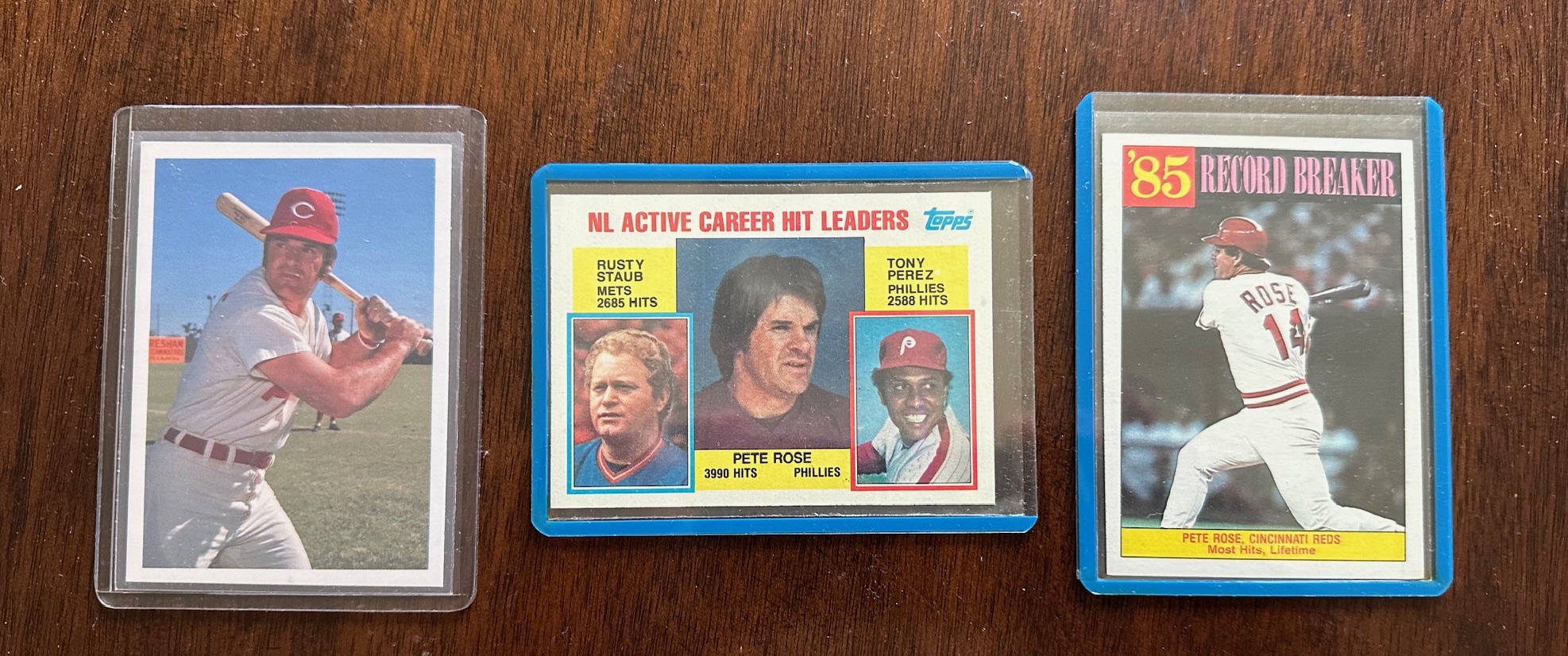
Earlier in 1999, The Sporting News ranked Rose as the 25th greatest baseball player of all-time. His place in baseball history is secure, with or without his deserved Hall of Fame induction. Pete Rose was a flawed human--as we all are--but he set a great example on the field by playing hard and playing to win. I vividly remember the second half of his playing career, and it was a joy to watch him play. For a kid in the 1960s-1980s, it was a delight to pull a Pete Rose baseball card from a pack or to find a Pete Rose baseball card in a hobby shop. Here are three of my Pete Rose baseball cards:

The first baseball cards that I remember getting were the Kellogg's 3-D Super Stars cards. I still have both Pete Rose cards from that series that I got as a kid:


The captions to those cards are poignant in retrospect. 

The first card's caption declares, "The NL leader in hits, runs, and doubles last year, Pete's 11th .300 season and his eighth with 200 hits enabled the Cincy superstar to continue his ascent to Cooperstown fame."

The second card's caption describes Rose's quest to break Cobb's all-time hits record and asserts, "No one, of course, is betting against 'Charlie Hustle.'"

I met Pete Rose at the 2004 National Sports Collectors Convention, which I attended with a press credential so that I could interview basketball legends (including Dolph Schayes). What does one say as an adult upon meeting a childhood sports hero who did so much for baseball but also has been exiled from baseball for breaking the sport's cardinal rule? I walked up to Rose, shook his hand, and thanked him for all of the joy I felt watching him play. He looked me in the eye, and said, "You're welcome." Unlike Jim Gray, I did not feel the need to corner Rose and demand that he answer for his past lapses. Rose gave so much to the sport of baseball and its fans, and he suffered the pain of baseball exile until his last day on Earth.

Rest in peace, Pete--and thanks for the joyful childhood memories!

Saturday, October 25, 2008

Rays and Phillies Combine Old School Wisdom With New School Thinking

The superficial take on the World Series is that it pits a new school, "Moneyball"-style Rays team versus an old school, by the book Phillies team. After all, Rays' General Manager Andrew Friedman, 31, got his start in the business world and relies on statistical analysis to construct his roster, while Phillies' General Manager Pat Gillick, 71, is a classic old school talent evaluator; USA TODAY's Bob Nightengale writes, "If you want to really get to know a player, Gillick says, you don't look at numbers. You look at his heart and soul." However, as Nightengale points out elsewhere in the same piece, a major reason that these two teams are so successful is that they have blended old and new approaches instead of blindly relying solely on observation or exclusively on statistics: "There's an obvious age difference between Pat and Andrew," Rays scouting director R.J. Harrison tells Nightengale. "But they are more alike than people think, and, I think, so are the philosophies of the two organizations. Pat Gillick is the ultimate general manager and is a traditional scouts' man, but Andrew has an incredible foundation of old-school ideas in this game, too. It's just that he incorporates statistical analysis to go along with it. You have to stay current and have to remain flexible to survive in this game and that's what we've done."

Some people try to create a schism between those who primarily believe in the value of observing players firsthand versus those who primarily believe in the value of using statistical analysis to evaluate players. The reality is that any organization that is intelligently run utilizes the best aspects of both of these approaches. I have never criticized statistical analysis in theory but only specific examples of faulty statistical analysis; I definitely think that it is important to incorporate statistics into the player evaluation process but I fervently disagree with anyone who says that any set of numbers can wholly replace the input of a scout who has an "educated eye." It also must be said that it is much simpler to effectively and meaningfully apply statistical analysis to baseball than basketball; baseball is a game that is played station to station and consists of a series of discrete one on one showdowns between the pitcher and the hitter, while basketball is a game of constant motion involving 10 players interacting in ways that are not easy to quantify and, indeed, are frequently quantified inaccurately even with regard to the simple box score numbers that "stat gurus" simultaneously deride for being insufficiently descriptive and yet use as the foundation for their more sophisticated metrics: the old phrase "garbage in, garbage out" applies here, because to the extent that the box score numbers are subjective and/or simply wrong, the metrics that are based on those numbers are also skewed.