Showing posts with label Pete Rose. Show all posts

Tuesday, June 10, 2025

George Foster's Hitting Powered the Big Red Machine

When remembering the glory days of the Big Red Machine, the first names that come to mind are Pete Rose, Johnny Bench, Joe Morgan, Tony Perez, and manager Sparky Anderson. Bench, Morgan, Perez, and Anderson are members of the Baseball Hall of Fame, and Rose would be a member as well if he had not been removed from the ballot because of the lifetime ban imposed by Commissioner Bart Giamatti in 1989. 

George Foster is not included in the same hallowed category as Rose, Bench, Morgan, Perez, and Anderson, but the significant contributions that Foster made to the Big Red Machine should not be forgotten.

Foster was a dominant slugger in the mid to late 1970s, winning the 1977 NL MVP while earning All-Star selections from 1976-79 and again in 1981, when he also finished third in NL MVP voting while capturing the Silver Slugger award. Foster batted .289 with three home runs and 12 RBI in 23 career postseason games, including .326 in 13 World Series games as he helped the Reds win back to back World Series titles in 1975-76. He ranked among the NL's top 10 home run hitters nine times (1975-81, 1983-84), including winning a pair of NL home run titles in 1977-78. In his 18 season MLB career, Foster bashed 348 home runs, collected 1239 RBI, and batted .274 with four seasons of .300 or better. 

Here are front and back pictures of two Kellogg's 3-D Super Stars cards featuring George Foster:


On Saturday June 7, my daughter Rachel and I went to the Dayton Dragons "Meet the Team" event, where we got our picture taken with George Foster:


Before the photographer took the picture, I shook Foster's hand, told him that he and the Big Red Machine were a memorable part of my childhood, and recited some of the statistics listed above, noting that I have explained to Rachel how much he accomplished, including having the only 50 home run season between Willie Mays (1965) and Cecil Fielder (1990). Foster's eyes opened wide, and he said quietly, "Not too many people know that. You memorized my stats!"

That brief interaction inspired me to write this article so that more people will remember and appreciate Foster and his outstanding MLB career.

Foster began his career with the San Francisco Giants as a third round draft pick who steadily improved until he became one of the best sluggers of his era. With the Giants, he did not advance past being the fourth outfielder behind Willie Mays, Bobby Bonds, and Ken Henderson. Early during the 1971 season, the Giants traded Foster to the Cincinnati Reds for shortstop Frank Duffy and pitcher Vern Geishert. The 1970 Reds lost 4-1 to the Baltimore Orioles in the World Series, but the 1971 Reds did not qualify for postseason play. In 104 games with the 1971 Reds, Foster ranked fifth on the team in home runs (10) and RBI (50). Overall, he had 13 home runs and 58 RBI that season. In 1972 and 1973, Foster had stints in the minor leagues while also playing a reserve role with the Reds. He participated in three of the Reds' 12 postseason games in 1972 as the Reds beat the Pittsburgh Pirates 3-2 in the NLCS before losing 4-3 to the Oakland A's in the World Series. In 1974, Foster had seven home runs and 41 RBI in 106 games with the Reds. 

In 1975, manager Sparky Anderson moved Pete Rose from left field to third base to create room in the starting lineup for Foster, and the Reds won 108 regular season games to tie the 1970 Baltimore Orioles for the most regular season wins by a team in the 1970s; that total is still tied for 10th on MLB's all-time single season wins list for teams, and was not matched again until the 1986 New York Mets won 108 games. Foster ranked third on the team in home runs (23, seventh in the NL), fourth in RBI (78), and fourth in batting average (.300). In the 1975 World Series, Foster hit .276 with two RBI as the Reds beat the Red Sox 4-3 to claim their first title since 1940.

In 1976, Foster claimed the first of his three consecutive NL RBI titles with an MLB-leading 121 while also ranking fourth in the NL in home runs (29), ninth in runs scored (86), and 10th in hits (172). He finished second in NL regular season MVP voting behind Joe Morgan. The Reds went undefeated in the 1976 postseason, the only team to accomplish that feat in the Divisional era, which started in 1969. Foster led the 1976 Reds in postseason RBI (eight) and ranked second in home runs (two). 

Foster led MLB in home runs (52), RBI (149), slugging percentage (.631), and total bases (388) in 1977. He missed out on the NL triple crown by .018 in the batting average race, finishing third (.320). He led the NL in runs scored (124). Foster won the NL regular season MVP, and it is unfortunate that his remarkable production has faded from memory. Long before performance-enhancing drugs (PEDs) defiled MLB's once hallowed record book, Foster set a single season Reds home run record that still stands, and at that time he was just the 10th MLB player to have a 50 home run season. Foster also still holds the team's single season RBI record.

Foster belted an NL-leading 40 home runs in 1978, and he won his third straight NL RBI title with 120. No NL player has won three consecutive RBI titles since 1978. He finished sixth in NL regular season MVP voting.

Injuries limited Foster to 121 games in 1979, but he still led the Reds in home runs (30, sixth in the NL) and RBI (98, sixth in the NL). After a two year absence from postseason play, the Reds won the NL West with a 90-71 record before being swept 3-0 in the NLCS by the "We Are Family" Pittsburgh Pirates, who went on to win the World Series.

The Reds began dismantling the Big Red Machine, but Foster remained productive. He ranked eighth in the NL in home runs (25) and RBI (93) in 1980, and during the strike-shortened 1981 season he ranked third in the NL in home runs (22) and second in RBI (90). Foster finished third in 1981 NL regular season MVP voting. Foster was included in the 1981 book "The 100 Greatest Baseball Players of All Time" by Lawrence Ritter and Donald Honig.

Prior to the 1982 season, the Reds traded Foster to the New York Mets for Greg Harris, Jim Kern, and Alex Trevino. Foster did not play well in 1982, but he bounced back in 1983 to rank sixth in the NL in home runs (28) and eighth in RBI (90). Foster again ranked sixth in the NL in home runs (24) in 1984. He had his last 20 home run season (21) in 1985 with the Mets before splitting the 1986 season with the Mets and the Chicago White Sox.

Hall of Fame voting is subjective with the exception of a few obvious first ballot choices, and it is an unfortunate reality that popularity with the media members who vote is a factor for candidates who did not post signature career numbers such as 500 career home runs, 1500 career RBI, or a .300 career batting average. The soft-spoken Foster never received serious consideration during the four years that he appeared on the Hall of Fame ballot. A strong argument could be made that he deserves to be a Hall of Famer based on playing a key role for dominant back to back World Series champions along with being a productive home run hitter and RBI producer for nearly a decade. Foster's AL contemporary, Jim Rice, posted similar career numbers and had to wait until his 15th (and final) year of eligibility before he was selected as a Hall of Famer in 2009. Since Foster is no longer on the ballot, his only chance is to be selected by the Era Committee. Foster was selected as a member of the Cincinnati Reds Hall of Fame in 2003.

Wednesday, October 2, 2024

Remembering Pete Rose, "The Hit King"

"I'd walk through hell in a gasoline suit to play baseball"--Pete Rose

The best, worst, and most accurate thing that you can say about Pete Rose is that he did it his way. Peter Edward Rose--also known as "Charlie Hustle" and "The Hit King," but forever known as "Pete" to his adoring fans--passed away on Monday at the age of 83. During a 24 year career spent mainly with the Cincinnati Reds and also including time with the Philadelphia Phillies (1979-83) and Montreal Expos (1984), Rose set many MLB records, but none are more impressive or meaningful than the career hits record; Rose bashed 4256 hits, eclipsing a Ty Cobb mark that stood for over 50 years. A player averaging 200 hits per season for 20 years would not match what Rose accomplished, so it is fair to suggest that Rose--who has been "The Hit King" since 1985--will remain number one for a long time.

Other MLB records held by Rose include being the only player to play at least 500 games at five different positions (first baseman, second baseman, third baseman, right fielder, and left fielder), most seasons with 150 or more games played (17), most seasons with 100 or more games played (23), most career runs by a switch hitter (2165), most career doubles by a switch hitter (746), most consecutive seasons with at least 100 hits (23), and most seasons with at least 200 hits (10, a mark shared with Ichiro Suzuki). A popular catchphrase declares "Chicks dig the long ball," but Rose did it his way without being a home run slugger, and he achieved his goal of becoming the first $100,000 singles hitter at a time when making $100,000 a year as a baseball player was a rare feat.

Rose participated in 1972 MLB games that his team won, a record that is unlikely to ever be approached. Rose was fond of pointing out that he won more games than the total number of games played by the legendary Joe Dimaggio (1736)!

Rose holds the NL marks for most years played (24), most career runs (2165), most career doubles (746), and most career games with at least five hits (10). The Cincinnati Reds Record Book could be renamed "The Pete Rose Story," as Rose is the franchise's career leader in games (2722), plate appearances (12,344), runs (1741), hits (3358), singles (2490), doubles (601), and walks (1210). Reds' principal owner and managing partner Bob Castellini said, "Our hearts are deeply saddened by the news of Pete's passing. He was one of the fiercest competitors the game has ever seen, and every team he played for was better because of him. Pete was a Red through and through. No one loved the game more than Pete and no one loved Pete more than Reds Country. We must never forget what he accomplished."

Not only did Rose make the All-Star team 17 times, he is the only player in MLB history to be selected as an All-Star at five different positions: second baseman, left fielder, right fielder, third baseman, and first baseman. In Rose's era, the All-Star Game was not treated as an insignificant exhibition game but rather as a highly competitive battle between the National League and the American League. Perhaps no player took that spirit of competition as seriously as Rose, as exemplified by the famous (or infamous, depending on your perspective) play at home plate in the 1970 MLB All-Star Game when Rose bowled over catcher Ray Fosse to score the winning run in the bottom of the 12th inning. Fosse injured his shoulder on the play and was never fully healthy again. Asked about the play years later, Rose regretted that Fosse got hurt but did not regret his action, stating that playing all out is the only way to play the game. That was the NL's eighth straight All-Star Game win and, after losing in 1971, the NL won the next 11 All-Star Games.

Rose won the 1975 World Series MVP, the 1973 NL regular season MVP, the 1963 NL Rookie of the Year award, and three NL batting titles (1968-69, 1973). He won two Gold Gloves (1969-70), and when he retired in 1986 he not only had the highest MLB career fielding percentage for a right fielder but he also had the highest NL career fielding percentage for a left fielder.

In 1978, Rose's 44 game hitting streak electrified baseball fans, and it is still the third longest such streak in MLB history. I am too young to have clear memories of the Big Red Machine's 1975-76 glory days, but I remember Rose's hitting streak being much discussed on TV and radio during the summer of 1978, and I recall the daily updates in local newspapers. 

Rose's teams went 9-5 in postseason series as he hit .321, including .370 in the 1975 World Series. Rose's teams won three World Series titles (1975-76 with his hometown Cincinnati Reds, 1980 with the Philadelphia Phillies). The 1976 Reds are the only team in MLB's two round playoff era (1969-93) to go undefeated, sweeping first the Philadelphia Phillies and then the New York Yankees. Rose was an integral member of the powerful Big Red Machine teams that reached the World Series four times (1970, 1972, 1975-76) in a seven season span.

Rose helped the Phillies win their first World Series title after they fell short in three straight NLCS losses (1976-78) prior to his 1979 arrival in Philadelphia. Hall of Fame third baseman Mike Schmidt enjoyed some of his finest moments--including winning his only World Series and capturing two of his three NL regular season MVPs (1980-81)--as Rose's Philadelphia teammate. Schmidt issued this statement after Rose's passing: "My heart goes out to his family. I was lucky that I got to play with Pete and to watch him every day. As a teammate, he boosted my confidence, he made me laugh and kept me loose. He taught me to enjoy the game, perhaps advice that I needed the most."

The negative side of Rose doing things his way involved illegal gambling, culminating in betting on baseball games while he served as the Reds' manager from 1984-89 (including a stint as MLB's last player-manager from 1984-86). Despite a mountain of evidence stacked against him, Rose adamantly denied betting on baseball until he admitted the truth in 2004. Nevertheless, he accepted a lifetime ban from MLB in 1989 with an option to seek reinstatement. It must be emphasized that the lifetime ban barred Rose from participating in MLB in any capacity but DID NOT prevent the writers from voting him into the Baseball Hall of Fame should they choose to do so after he became eligible; a 1991 ruling by the Baseball Hall of Fame board rendered Rose ineligible to be elected, taking the decision out of the hands of the baseball writers. In 2008, the Baseball Hall of Fame's Veterans Committee passed a similar rule. Both rules primarily--if not exclusively--target Rose. I analyzed this topic at length in 2015, and I concluded that it is wrong to keep Rose off of the Hall of Fame ballot:

I understand the argument that Rose's character flaws should keep him out of the Baseball Hall of Fame. I have made it clear that MLB's PED cheaters should not be inducted in the Hall of Fame because they have defiled MLB's record book. What Rose did is terrible and the way that he denied his conduct for years before begrudgingly making some admissions says a lot about Rose's character but the difference between Rose and the PED cheaters is that there is no evidence that Rose's gambling impacted the quality of his play or defiled the sport's record book. Rose should be placed on the Baseball Hall of Fame ballot and if he is voted in then his plaque should not only list his pertinent accomplishments but also state that in 1989 he was placed on the permanently ineligible list because he bet on baseball. Unless or until there is evidence that Rose's playing career/statistics are tainted by his gambling Rose deserves at least the opportunity to be selected as a Baseball Hall of Famer. The lifetime ban from the sport shields MLB from any damage that Rose's compulsive gambling could cause now and punishes him in a way that will hopefully deter others from making the mistakes that he did.

The argument in favor of Rose's Hall of Fame candidacy is bolstered by the fact that MLB--like most other major sports leagues--has now fully embraced and profited from sponsorship deals directly connected with promoting gambling, in marked contrast to the decades-long notion that any affiliation with wagering would taint sports. That cultural shift does not justify Rose's conduct--he broke the rule in place at that time, and that rule is still in place now--but it is hypocritical for MLB to profit from promoting gambling while taking such an unforgiving stance toward the "Hit King," and I reiterate my position that Rose should be made eligible for Hall of Fame induction.

Despite MLB's lifetime ban, Rose was selected to MLB's All-Century Team in 1999. During the on field ceremony, reporter Jim Gray--acting as if he were a candidate for a prize in investigative reporting--grilled Rose on national TV about the gambling scandal. Rose, like most of the audience, was surprised that Gray pursued that line of questioning at that moment. There is a proper time and place for everything, and that was neither the proper time or place. Rose deserved to celebrate that moment without being interrogated and humiliated.

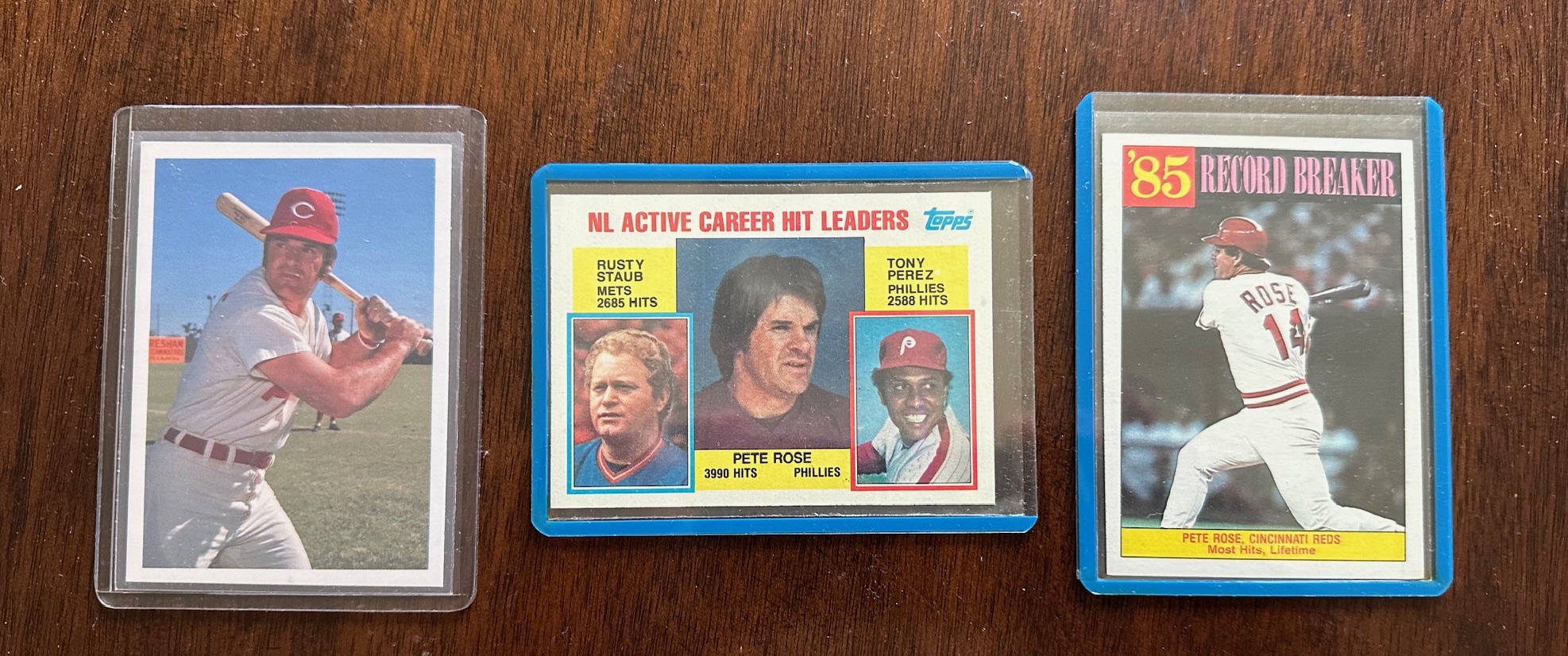
Earlier in 1999, The Sporting News ranked Rose as the 25th greatest baseball player of all-time. His place in baseball history is secure, with or without his deserved Hall of Fame induction. Pete Rose was a flawed human--as we all are--but he set a great example on the field by playing hard and playing to win. I vividly remember the second half of his playing career, and it was a joy to watch him play. For a kid in the 1960s-1980s, it was a delight to pull a Pete Rose baseball card from a pack or to find a Pete Rose baseball card in a hobby shop. Here are three of my Pete Rose baseball cards:

The first baseball cards that I remember getting were the Kellogg's 3-D Super Stars cards. I still have both Pete Rose cards from that series that I got as a kid:


The captions to those cards are poignant in retrospect. 

The first card's caption declares, "The NL leader in hits, runs, and doubles last year, Pete's 11th .300 season and his eighth with 200 hits enabled the Cincy superstar to continue his ascent to Cooperstown fame."

The second card's caption describes Rose's quest to break Cobb's all-time hits record and asserts, "No one, of course, is betting against 'Charlie Hustle.'"

I met Pete Rose at the 2004 National Sports Collectors Convention, which I attended with a press credential so that I could interview basketball legends (including Dolph Schayes). What does one say as an adult upon meeting a childhood sports hero who did so much for baseball but also has been exiled from baseball for breaking the sport's cardinal rule? I walked up to Rose, shook his hand, and thanked him for all of the joy I felt watching him play. He looked me in the eye, and said, "You're welcome." Unlike Jim Gray, I did not feel the need to corner Rose and demand that he answer for his past lapses. Rose gave so much to the sport of baseball and its fans, and he suffered the pain of baseball exile until his last day on Earth.

Rest in peace, Pete--and thanks for the joyful childhood memories!

Wednesday, January 26, 2022

Baseball Hall of Fame Voters Correctly Shut the Door on Bonds and Clemens, but Give a Pass to Ortiz

In Hall of Fame balloting conducted among members of the Baseball Writers Association of America, David Ortiz received 77.9 percent of the votes, surpassing the 75 percent threshold for induction. Although Ortiz is the only player selected by the media, he will not be the only inductee this summer. He will be joined by six players who were selected by various Hall of Fame committees: Gil Hodges, Tony Oliva, Minnie Minoso, Jim Kaat, Bud Fowler, and Buck O'Neil. Kaat, Oliva, and Ortiz are the only 2022 inductees who are alive.

Ortiz ranks 17th on MLB's regular season home run list, his teams won three World Series championships (2004, 2007, 2013), and he won the 2013 World Series MVP. He is a first ballot inductee, but barely. Why did he not receive more votes? One reason is that he spent most of his career as a designated hitter, and Hall of Fame voters have typically passed on players who spent most of their careers as a designated hitter (with a few notable exceptions, including--most recently--Edgar Martinez, inducted in 2019). 

The other reason is that it is likely, but not definitively proven, that Ortiz used performance-enhancing drugs (PEDs) during his career.

In a recent article, Sports Illustrated's Tom Verducci noted that prior to 1996 there had never been an MLB season in which 12 players each hit at least 40 home runs. Then, at least 12 players each hit 40 home runs for six straight years. Verducci's 2002 SI story about rampant steroid use in MLB shamed Congress into action, and led to MLB taking the first tentative steps to test players and assess the problem. Ever since MLB began testing, there has never been another season in which at least 12 players each hit 40 or more home runs; the bloated home run numbers are tainted and, as I wrote in 2009, MLB's record book should be shelved in the fiction section.

Here are a couple player quotes from Verducci's 2002 article:

Pitcher Matt Herges declared, "I know what steroids did for me. It made me superhuman. It made me an android, basically. Your body shuts down and the stuff takes over."

Pitcher Dan Naulty said, "I was a full blown cheater and I knew it. You didn't need a written rule. I was violating clear principles that were laid down within the rules."

PEDs are called "performance-enhancing" because they enhance performance: they help pitchers throw faster and harder, and they help batters swing faster and harder. "Stat gurus" have trouble grasping this basic concept, but anyone with common sense understands why the players cheated, and anyone whose moral compass is functioning understands why the cheaters should not be inducted in the Baseball Hall of Fame. In 2012 Mark McGwire--who spent a long time evading the topic but eventually admitted that he used steroids--said, "It's a mistake that I have to live with for the rest of my life. I have to deal with never, ever getting into the Hall of Fame. I totally understand and totally respect their opinion and I will never, ever push it."

Ortiz tested positive for PEDs in 2003, though those test results did not become public knowledge until 2009. Ortiz was not productive during the early portion of his career, but he turned things around after he was released by the Minnesota Twins in 2002. At that time, he was 26 years old, and he had never hit more than 20 home runs in a season, nor had he ever slugged more than 75 RBI in a season. In 2003, the year that Ortiz tested positive, he had 31 home runs and 101 RBI in his first season with the Boston Red Sox. In 2004, Ortiz had 41 home runs and 139 RBI, followed by 47/148 and 54/137 in 2005 and 2006. MLB's PED testing program began during the 2006 season (the 2003 tests were "survey" tests to assess the extent of the problem, with the results not publicized, and with no players being disciplined even though steroids were and are illegal without a prescription). A player who stopped taking PEDs that season would be able to pass drug tests but still likely benefit from the residual effects and the muscle mass already built. Ortiz was just 30 years old, and he played 10 more years until he was 40, but he never hit more than 40 home runs in a season, though he was very productive even at age 40 (38 home runs, 127 RBI). It must be emphasized that Ortiz' production after PED testing was implemented does not prove that he was clean: it may be possible to cycle usage in a way to avoid detection, and--even more to the point--research has shown that even brief PED use can confer long-term strength gains.

So, the facts that we know are that Ortiz was a mediocre player at best until he was 26, he suddenly became good around the same time that he tested positive for PEDs, PEDs can provide a long-term advantage even after usage is discontinued, and neither Ortiz nor anyone else has provided a public explanation for Ortiz' positive test. It is not surprising that MLB, not wanting to have yet another star tainted, has stood behind Ortiz, because the evidence against him is easier to sweep under the rug than the massive evidence against Roger Clemens, Barry Bonds, Mark McGwire, Sammy Sosa, Alex Rodriguez, Manny Ramirez, Rafael Palmeiro, and many other players. It is worth mentioning that Ramirez and Ortiz were teammates on two World Series championship teams. Like Ortiz, Ramirez tested positive in 2003; Ramirez also tested positive a second time after MLB instituted penalties for positive tests, and he was suspended for 50 games during the 2009 season. MLB loves to publicize how the Red Sox overcame the "curse" to win three World Series, but the fact that the team's two best sluggers both tested positive for PEDs is brushed under the carpet (Ramirez played for the 2004 and 2007 championship teams, while Ortiz played for all three championship teams).

Verducci, who is a Hall of Fame voter, voted for Ortiz, as he does not believe that one failed test whose results were not supposed to be publicly released should disqualify Ortiz. I respect Verducci--one of the best baseball writers of all-time--but I respectfully disagree. You can be convicted in court based on circumstantial evidence, and I think that the circumstantial evidence cited above is sufficient to keep Ortiz out of the Hall of Fame, or to at least delay voting for him unless/until he is more forthcoming about his positive test.

Bonds and Clemens finished second and third in the 2022 voting. This was the final year on the ballot for both of them. Alex Rodriguez finished 10th in the 2022 voting. MLB suspended Rodriguez for the entire 2014 regular season and the entire 2014 postseason not only for using PEDs but for actively obstructing MLB's investigation of his illegal conduct. He should have been banned from the sport for life, not invited back to become a highly paid MLB analyst. Manny Ramirez finished 12th in the 2022 voting, while Sosa finished 14th.

Curt Schilling not only was not tainted by PED use, but while the PED usage was at its highest he was an outspoken critic of players who cheated by using illegal drugs. Schilling did more than enough to earn induction, but many media members do not like him because of various opinions that he has expressed, and thus Schilling only finished fifth in the balloting in his final year of eligibility. In case you forgot, never knew, or are too young to remember, Schilling posted an 11-2 postseason record, including 5-0 in elimination games. His .846 postseason winning percentage is the all-time record for pitchers with at least 10 postseason decisions. He played for three World Series champions (2001, 2004, 2007), and he won the 2001 World Series MVP. Four pitchers in MLB history have struck out 300 or more batters in a season at least three times: Sandy Koufax, Nolan Ryan, and Randy Johnson. Schilling is the only one of the four who has not been inducted in the Hall of Fame. Schilling won 216 regular season games, with a .597 winning percentage. He is one of 19 members of the 3000 strikeout club, and he has the best strikeout to walk ratio in that elite club. 

Let me be perfectly clear: I did not root for Schilling or his teams, and I disagree with some things that he has said and done. Whether you like a person or agree with a person has nothing to do with that person's qualifications to be a Hall of Famer; I understand that, but many biased media members who have been given the privilege of filling out a Hall of Fame ballot fail to understand that.

It must be noted that the PED cheaters not only caused damage during their own era, but the artificially inflated home run numbers of Bonds, McGwire, and others made it even more difficult for clean sluggers from previous eras to be inducted. Dale Murphy should have made the Hall of Fame a long time ago, but his career numbers--including 398 home runs--now look pedestrian alongside the counterfeit numbers posted by the cheaters. Murphy won back to back National League MVPs (1982-83) while leading the league in RBI during both of those seasons, and then he led the NL in home runs in 1984 and 1985 while earning two more top 10 MVP finishes. He smashed a career-high 44 home runs in 1987 during a run of nine straight seasons during which he hit at least 20 home runs (he had 36 or more home runs in five of those seasons). A 20 home run season may not seem impressive after the fake pyrotechnics of McGwire-Sosa-Bonds and the other cheaters, but Murphy finished in the NL's top four in home runs seven times, including six top three finishes. Murphy not only won four Silver Slugger awards but he also earned five Gold Gloves. He was a complete player who did things the right way, and he has been unjustly forgotten by history and by the Hall of Fame voters.

Players who fail to be elected after 10 years on the ballot can still become Hall of Famers if they are selected by a committee comprised of executives, players, and media members. As mentioned above regarding the 2022 inductees, often that recognition does not happen until after the player has died.

Bonds came within 10 percent of the vote of receiving Hall of Fame induction this year. Pete Rose, the all-time hit king who played for three World Series championship teams, never appeared on the ballot, and it does not seem likely that his candidacy will receive serious consideration during his lifetime. After Rose accepted a lifetime ban from MLB because of his gambling, the Baseball Hall of Fame created a rule making Rose ineligible to appear on the ballot, and later the Hall created a rule making him ineligible for consideration by the Veterans Committee.

All of the major sports leagues--including MLB--now reap major profits from partnerships with gambling entities, but Rose is still stuck in permanent pariah status. 

It is ridiculous that Bud Selig--perhaps the worst commissioner of a major sports league in my lifetime, if not longer--has been inducted in the Baseball Hall of Fame while Rose, Murphy, and Schilling have not been inducted. 

I hope that Rose, Murphy, and Schilling are elected as soon as possible, and I just as fervently hope that the Baseball Hall of Fame never opens its hallowed doors to the PED cheaters who permanently stained the sport.

Tuesday, December 15, 2015

Pete Rose Does not Belong Back in Baseball but He Belongs in the Baseball Hall of Fame

Pete Rose broke Major League Baseball's fundamental rule about gambling on the sport and he lied about breaking that rule. He deserved to receive a harsh punishment and he has received a harsh punishment: Rose accepted a lifetime ban in 1989. That ban came with a proviso enabling Rose to apply to the MLB Commissioner for reinstatement after one year but now that Rob Manfred has become the third consecutive MLB Commissioner to reject Rose's application for reinstatement it appears that Rose's lifetime ban will most likely never be lifted.

It is understandable why MLB refuses to let Rose have an active role in the sport as an executive, field manager or instructor. Rose continues to bet on sports--including baseball--and even though Rose now apparently does his gambling legally he has failed to "reconfigure his life," which was the standard imposed upon him in order to be reinstated. If Rose were not a compulsive gambler and/or a very stubborn/defiant person then he would have stopped gambling completely and stopped associating himself with casinos. Rose's complaint that this is the only way he can support himself after being banned from baseball does not hold water; Rose remains an immensely popular figure who does not need to be involved with gambling in order to support himself.

If Rose were permitted to work in baseball this would not only reduce the deterrence value of the lifetime ban but it would also potentially create huge problems; Rose clearly cannot stop gambling and if he has access to insider knowledge about baseball players and teams then the possibilities for fixing games (or simply having an unfair advantage as a wagerer) are huge. That is not to say that Rose ever fixed a game or that he would fix a game now but it is understandable that MLB does not want to take such a risk with a compulsive gambler who is also a serial liar.

Rose would have a lot to offer to the sport if he had not chosen this life path but he has to suffer the natural consequences of his mistakes. Rose's exile from the sport he loves is tragic but it is a self-imposed tragedy and it is a tragedy that he could have mitigated over the past few decades if he had made some sincere efforts to "reconfigure his life." Rose reminds me of an alcoholic who says "I can stop drinking whenever I want" but refuses to stop drinking even if the alcohol consumption could harm the alcoholic and/or others. Rose needs intensive therapy/treatment to control his gambling addiction and he has never sought out that help; that is his prerogative and if all of his gambling activities now are legal then no one has the legal authority to stop him but MLB provided Rose with a standard for reinstatement--life reconfiguration--and Rose has failed to meet that standard.

However, Rose's eligibility for Hall of Fame induction should be restored. When Rose agreed to accept the lifetime ban with the possibility of applying for reinstatement, he did not forfeit his eligibility for Baseball Hall of Fame induction. Rose became ineligible for the Baseball Hall of Fame on February 4, 1991, when the Baseball Hall of Fame passed a rule prohibiting anyone who is on MLB's permanently ineligible list from being inducted in the Baseball Hall of Fame. Rose is the only living person on the permanently ineligible list, which means that the rule was passed purely to exclude him (it may theoretically exclude other people in the future but he is the only living person affected by the rule now). Without this new rule, Rose would have appeared on the Baseball Writers Association of America Hall of Fame ballot from 1992-2006. The writers could have studied the evidence at their leisure and made their own determination about whether or not Rose belongs in the Baseball Hall of Fame. Clearly, based on the merits of his skills and accomplishments, Rose would be a first ballot Hall of Famer. A case could be made that based on character he should be excluded--but the writers should at least have been given the opportunity to pass judgment and to consider that judgment over a 15 year period (assuming that Rose did not make it in immediately).

The Veterans Committee examines the Hall of Fame candidacies of any eligible candidate for the Baseball Hall of Fame who is not selected after being on the BBWAA ballot but in 2008 the Veterans Committee passed a rule barring anyone from the permanently ineligible list from being considered for Hall of Fame induction. Again, this is a rule that primarily if not exclusively affects Rose.

I understand the argument that Rose's character flaws should keep him out of the Baseball Hall of Fame. I have made it clear that MLB's PED cheaters should not be inducted in the Hall of Fame because they have defiled MLB's record book. What Rose did is terrible and the way that he denied his conduct for years before begrudgingly making some admissions says a lot about Rose's character but the difference between Rose and the PED cheaters is that there is no evidence that Rose's gambling impacted the quality of his play or defiled the sport's record book. Rose should be placed on the Baseball Hall of Fame ballot and if he is voted in then his plaque should not only list his pertinent accomplishments but also state that in 1989 he was placed on the permanently ineligible list because he bet on baseball. Unless or until there is evidence that Rose's playing career/statistics are tainted by his gambling Rose deserves at least the opportunity to be selected as a Baseball Hall of Famer. The lifetime ban from the sport shields MLB from any damage that Rose's compulsive gambling could cause now and punishes him in a way that will hopefully deter others from making the mistakes that he did.

Wednesday, July 16, 2008

Michael Young Helps MLB Avoid its Worst Nightmare: Another All-Star Game Tie

Michael Young's sacrifice fly in the bottom of the 15th inning not only gave the American League a 4-3 win over the National League in the All-Star Game but it averted the potential of yet another major embarrassment for Major League Baseball and Commissioner Bud Selig. The abominable 11 inning, 7-7 tie in the 2002 All-Star Game was bad enough but if this contest resulted in a tie or turned into a farce with position players pitching it would have been yet another black eye for a sport that has seen plenty of them during Selig's reign. Ever since the 2002 fiasco, the All-Star Game has decided home field advantage in the World Series, so apparently this time around the teams would have stayed on the field until some position player blew out his arm trying to pitch.

J.D. Drew went 2-4 with a two run home run, a walk and a stolen base to claim MVP honors and the relief on Selig's face was palpable when he awarded Drew the MVP trophy. The game obviously did not have too many offensive highlights and, frankly, the first six innings were pretty boring. The only truly memorable plays during that time were a solo home run in the fifth inning by Matt Holliday and a great throw by Ichiro Suzuki to gun down Albert Pujols at second base, though replays indicated that Pujols probably beat the tag; still, it is amazing that a small guy like Ichiro has such a howitzer for an arm and Fox analyst Tim McCarver said that Ichiro is the best defensive right fielder he has seen since the legendary Hall of Famer Roberto Clemente.

While the early going was not exciting, things heated up in the seventh inning when Drew's two run shot tied the score and then the latter innings of this game featured numerous tremendous defensive plays by both teams, including several gems by Miguel Tejada and a number of bang bang plays at home plate that kept the score tied.

ESPN's Jayson Stark notes that a staggering number of records were set or tied in this All-Star Game, including, "Longest game ever (290 minutes). Most runners left on base ever (28). Most players in a box score ever (63). Most pitchers in an All-Star box score ever (23). Even most strikeouts ever (34)." The 15 innings tied a record set in 1967 and you can also add to the list of records the three errors committed by National League second baseman Dan Uggla, who also struck out three times and grounded into a double-play in what Stark aptly described as perhaps the worst All-Star performance ever.

This extra innings marathon would have been a lot more thrilling to watch if not for the dark cloud that hung over the last few innings: the very real possibility that one or both of the managers would run out of pitchers. Based on some of the interviews conducted after the game, it sounds like there was some kind of mandate from Selig that the game must have a decisive outcome no matter what, which could potentially have led to home field advantage in the World Series being decided with a position player on the mound. The only thing worse than that would be a position player--a franchise player for some team--blowing out his arm while pitching in an exhibition game.

The reason why this kind of issue never came up until recent years is that in the "good old days" the starting All-Stars played longer and there was an understanding that not every single player would get on the field if the game only went nine innings. Now, by trying to get the best of all worlds MLB annually opens up the possibility of living out a nightmare scenario: the game "counts" yet the managers try to get every player on the field (except for a few pitchers who are on the rosters but whose regular teams don't want them to pitch). If the game goes nine innings then everyone is happy but if it goes extra innings instead of celebrating baseball everyone is suddenly focused mainly on the possibility of the game ending in a tie or a farce with All-Stars playing out of position.

The other problem with the way that the All-Star Game is run is that a terrible strain is being placed on pitchers who have to warm up, then sit down, then warm up, then sit down, then go into the game. Apparently, Brad Lidge had thrown upwards of 100 warmup pitches in a two hour period before he entered the game for the National League in the 15th inning and got saddled with the loss.

The solution is simple: the starting pitchers for each team should go at least five innings, unless of course one of them is getting shelled and needs to come out sooner. Then a relief pitcher should come in for an inning or two and that process should be repeated until the end of the game. That way, guys are not repeatedly warming up and then sitting down, because they will know exactly when they are going in the game. Just being selected to the All-Star team is an honor and it is not practical to get every single player in the game. The fact is, the players who the fans voted in should get the lion's share of the innings anyway.

No one had to tell the players in the 1970s and 1980s that the All-Star Game "counted"; back then, the players felt tremendous pride in trying to win to assert the superiority of their league and that is another reason that starters (position players as well as pitchers) used to play more innings than they do now. If the game really "counts" then it should be managed more like a real game. Pete Rose ran over catcher Ray Fosse to score the winning run in the 12th inning of the 1970 All-Star Game precisely because, in Rose's mind, the game "counted"; he often has said that he could not have looked his father in the eye if he had played any other way and that he would have felt like he was cheating the fans if he did not play 100% at all times. Perhaps Rose took things to an extreme in that instance but that also reflects the intensity of the rivalry between the leagues at that time.

Speaking of Rose, I could not help but think of MLB's all-time hits leader during the pregame introductions when 49 Hall of Famers took the field at their old positions and greeted this year's All-Stars. It was great to see so many of the game's legends on the same field at the same time, let alone on the hallowed (and soon to be closed) grounds of Yankee Stadium. I also like that rather than single out one Yankee as the greatest or most worthy of recognition that Whitey Ford, Yogi Berra, Reggie Jackson and Rich "Goose" Gossage each simultaneously threw out ceremonial first pitches. Joe DiMaggio used to demand that he be introduced as the "Greatest living Yankee" but I like the way the Yankees chose to honor multiple stars (and eras) from their storied history.

Rose would surely have been a first ballot Hall of Famer if not for the Hall of Fame changing the rules after MLB banned Rose for life for the gambling that he did while managing the Cincinnati Reds after he retired as a player. In the first 55 years of its existence, the Hall of Fame never had a rule barring someone who is on the banned list from being on the Hall of Fame ballot but in 1991 the Hall hastily implemented such a rule just before Rose would have become eligible to appear on the Hall of Fame ballot. Thus, the Hall of Fame voters never had a chance to decide whether or not to vote him in, so Rose's situation differs completely from that of guys like Mark McGwire and Barry Bonds; many people believe that McGwire and Bonds used performance-enhancing drugs (PEDs) and thus McGwire has received few Hall of Fame votes and Bonds may also get much less support than he otherwise would have--but McGwire is on the ballot and as things stand now Bonds will be on the ballot as soon as he becomes eligible. Apparently, Rose is the only baseball player in history who MLB has decided is beyond redemption and forgiveness, something that is ironic and sad considering how Josh Hamilton is praised for overcoming his addictions and that the Hall of Fame has already opened its doors to someone who was suspended for one year for consorting with gamblers (Leo Durocher) and a player who was convicted of drug smuggling (Orlando Cepeda).

Rose was selected to the All-Star team 17 times and he started at five different positions (second base, left field, right field, third base and first base). If Rose had been allowed to participate in the pregame ceremony then MLB would have had to clone him in order for him to simultaneously be present at all the spots on the field where he played at an All-Star level. Yes, there are Hall of Famers who made the All-Star team at multiple positions but as far as I know Rose is the only player who started at five different positions in All-Star play.

The ceremony was great but I found myself wondering which position Rose would have represented and how big of an ovation he would have received. He received louder cheers than anyone else when MLB had to begrudgingly include him in a similar ceremony in 1999 when the All-Century Team was chosen. The difference in that case is that corporate sponsor MasterCard insisted on including Rose, a strong indication that MLB's stance regarding Rose is hypocritical and not truly a moral stance based on upholding the integrity of the game: basically, if the price is right then MLB will recognize Rose but otherwise he is ostracized. Rose committed a serious offense and I don't think that he should be allowed to manage again but it is terrible for MLB to act like his honestly achieved playing accomplishments never took place and it will be disgusting if even one PED cheater is inducted in the Hall of Fame, especially if Rose continues to be banned.

Thursday, July 10, 2008

Eric Davis: "Like Having an Atomic Bomb Sitting Next to You in the Dugout"

Baseball has never thrilled or excited me the way that some other sports--particularly basketball--do but a handful of great baseball players have captivated me as much as any athletes in any sport and right at the top of that list is the wondrous Eric Davis. In 1986 and 1987 it seemed possible that he might become the greatest all-around baseball player ever. If that statement sounds absurd to you, then check out the words that the equally incomparable Ralph Wiley used to open his May 25, 1987 Sports Illustrated cover story about Davis:

Let's get it straight from the beginning. Eric Davis is not Willie Mays or Henry Aaron or Roberto Clemente. Eric Davis is E. That's it, just E, the single-letter nickname his friends know him by. E's friends are everywhere now, and many of them never saw Mays or Aaron or Clemente. Children who play on scarred inner-city blacktops, manicured suburban lawns and wide-open country fields join E's legions with every sweet, vicious swing of his 32-ounce bat. That's E, as in Everything—which is what the new Cincinnati Reds star has.

"Eric is the one guy who can lead our league in home runs and stolen bases," says Pete Rose, Davis' manager. "Name me another cleanup hitter who can steal 100 bases. Name one. It's like having an atomic bomb sitting next to you in the dugout."

"Eric," says the Reds' six-time All-Star outfielder Dave Parker, "is blessed with world-class speed, great leaping ability, the body to play until he's 42, tremendous bat speed and power, and a throwing arm you wouldn't believe. There's an aura to everything he does. I tell you frankly that I'd pay to see him if I had to."

Everyone who has paid to see Eric Davis lately has gotten his money's worth. As most of America knows, E is off to one of the all-around best starts in National League history. His numbers: .358 average, 15 homers, 36 runs scored, 16 steals, 38 RBIs, and two weeks still remaining in the month of May. But it's the ease with which he has amassed these stats that has astonished older fans and enraptured younger ones. Meanwhile, baseball cognoscenti are left with an inescapable conclusion: To find an appropriate comparison for the soon-to-be 25-year-old outfielder, one must hark back to the '50s and '60s, to Mays and Aaron and Clemente.


Davis was the Swiss Army knife of five-tool players; he had more tools than Home Depot: Davis could hit for average, hit for power, run, field his position with amazing range/stunning grace and throw like he had a bazooka attached to his shoulder. He specialized in using whatever tool was necessary to win a particular game, delivering game winning RBI, game saving catches and game breaking steals with equal aplomb. Wiley noted that after a 2-0 Reds victory over the Mets during which Davis scored a run, stole three bases and robbed Darryl Strawberry of a home run with a catch of which Rose said, "I didn't think Superman could get to that ball," Mays commented, "It's an honor to be compared to Eric Davis. I hope Eric is honored." Aaron declared, "Eric Davis has unlimited ability—awesome ability. I don't think he'll be Willie Mays. That would take some doing. But, on the other hand, I don't think he has a weakness, either."

In that magical summer of 1987, Davis set NL records for grand slams in one month (three in May) and most home runs by the end of May (19). He won the NL Player of the Month Award in April and May. Although injuries limited him to 129 games, he still finished with 37 home runs (fourth in the NL), 100 RBI (eighth), 120 runs scored (third), 50 stolen bases (fourth), a .593 slugging percentage (second) and a .293 batting average. At that time he was just the seventh 30-30 player and he reached those numbers earlier in the season than anyone ever had. Davis was the first 30-50 player in MLB history, a feat later matched by Barry Bonds.

The previous season, Davis put up these gaudy numbers while playing in three more games but with 59 fewer at bats: 27 home runs (fifth in the NL), 71 RBI, 97 runs scored (third), 80 stolen bases (second) and a .523 slugging percentage (which would have ranked second if he had enough at bats to qualify). Davis and Rickey Henderson (who had 28 home runs and 87 stolen bases in 1986) remain the only 25-80 players in MLB history.

It may be hard for younger fans to believe but before Mark McGwire did whatever he does not want to talk about and Barry Bonds (allegedly) used various performance-enhancing drugs to become the not so jolly home run bashing Giant, a 30-plus home run season was quite an accomplishment, because 40 home run seasons were exceptional and 50 home run seasons were very rare. Only one player hit at least 50 home runs in a season between 1965 and 1976 (Willie Mays hit 52 in 1965), while between 1977 (George Foster, 52) and 1990 (Cecil Fielder, 51) no MLB player hit 50 or more home runs in a season; in many of the years between 1965 and 1990, 37 would have been good enough to be a league-leading total and Davis blasted that many home runs in 1987 despite missing a fifth of the season and being a premier base stealer.

Davis won three straight Gold Gloves (1987-89) and in both 1987 and 1989 he made the All-Star Team and won the Silver Slugger Award. He also won the 1989 Home Run Derby. Davis ranked in the top ten in the NL in home runs, slugging percentage and OPS (on base percentage plus slugging) each year from 1986-89. He was not only a prolific base stealer but also a very efficient one: Davis was never caught stealing in high school or in his first year of pro ball and his stolen base percentage of 84.1 ranks second in MLB history behind Tim Raines (84.7) ; Davis' 85.0 NL stolen base percentage is also second behind Raines (85.7).

In 1990, Davis had 24 home runs and 86 RBI for a Reds team that led the NL West wire to wire and then swept the powerful Oakland A's in the World Series. Davis hit a two-run home run in his first World Series at bat to give the Reds a 2-0 first inning lead in game one, setting the tone for a 7-0 victory over the defending World Champions. Davis was not able to celebrate the sweep with his teammates because he suffered a potentially life threatening kidney laceration while diving for a ball in the outfield during game four. He was hospitalized for 11 days. Reds' owner Marge Schott did not even pay for his plane ride back to Cincinnati and after Davis labored through an injury-riddled 1991 season the Reds traded him to the L.A. Dodgers.

Davis continued to struggle with his health and in 1993 the Dodgers traded him to the Detroit Tigers. A disc injury in his neck limited him to just 37 games in 1994 and he retired after that season. However, by 1996 Davis had recuperated sufficiently from his various ailments to attempt a comeback and he was literally a smashing success, blasting 26 home runs and 83 RBI in 129 games for the Reds. He even stole 23 bases. Davis won the NL Comeback Player of the Year Award but did not get along well with Manager Ray Knight and thus decided to sign with Baltimore as a free agent. Davis' Baltimore career hardly began before he was diagnosed with colon cancer. He vowed to return before the end of the season and was true to his word, overcoming surgery and chemotherapy to rejoin the team's lineup in September. Davis hit a ninth inning home run in the Orioles' 4-2 victory in game five of the ALCS but the Cleveland Indians won game six to advance to the World Series. Davis won the Roberto Clemente, Hutch and Tony Conigliaro Awards in 1997, honors that acknowledged his character, fighting spirit and ability to overcome adversity.

Although Davis was no longer a base stealing threat, in 1998 he proved that at 36 years of age he still had a lot of pop left in his bat, ranking fourth in the AL with a career high .327 average while hitting 28 home runs and notching 89 RBI. Davis ranked eighth in on base percentage (.388), ninth in slugging percentage (.582) and 10th in OPS (.970). He also had a 30 game hitting streak that season, setting an Orioles franchise record. Davis finished his career by playing two seasons in St. Louis and one in San Francisco.

We will never know for sure what Davis could have accomplished had he been healthier during his career but he hit at least 20 home runs in eight different seasons and he persevered long enough to amass 282 home runs and 349 stolen bases in 17 MLB seasons.

Friday, February 29, 2008

Roger Clemens Learns the Timeless Lesson: It's Not the Crime, it's the Coverup

You would think that everyone would have learned the lesson decades ago when the Watergate scandal brought down President Richard Nixon, who just a few years earlier had won reelection by a landslide margin: the American public has demonstrated on many occasions that it will forgive just about any transgression if the person who committed it apologizes and truly seems to be contrite--but if a public figure lies and steadfastly denies that he did anything wrong then those falsehoods almost inevitably bring him down. After Jason Giambi was exposed as a steroids user, a lot of criticism and hostility were directed toward him but he apologized and the matter seems to be largely forgotten; few people are saying that he should forfeit his 2000 AL MVP to second place finisher Frank Thomas (I actually think that he should be stripped of that honor in similar fashion to how track and field authorities stripped Marion Jones of her medals but I am less forgiving than the general public). The funny thing is that Giambi's apology was weak and vague and never even mentioned the word "steroids" but people still forgave him.

When the Mitchell Report first came out, Roger Clemens should have done a "Giambi." Like Giambi, Clemens is probably too arrogant to ever directly admit to using steroids but if Clemens had simply issued some kind of apology then his reputation would not be in its current Pete Rose death spiral. Think about the difference between Clemens and his friend/teammate Andy Pettitte: Brian McNamee testified under oath that he personally supplied illegal performance-enhancing drugs (PEDs) to both Pettitte and Clemens. Pettitte immediately admitted his PED use and no one is investigating him; he probably won't even be punished, even though he has hardly come clean completely about all of the circumstances surrounding his PED use (he did not initially admit to getting HGH from his father in addition to getting HGH from McNamee and I highly doubt that Pettitte's HGH use was as limited as he wants us to believe). Pettitte is literally a criminal and a cheater and yet he has emerged from this situation as some kind of paragon of integrity. Clemens is a bigger star than Pettitte and would have probably been subjected to harsher scrutiny but if MLB is not going after Giambi's MVP then I doubt that there would have been much effort made to go after Clemens' honors if he had not arrogantly and foolishly decided to defiantly proclaim his complete innocence.

Instead, Clemens has apparently lied under oath about matters great (illegal drug use) and small (attending a party at Jose Canseco's house), not only gravely damaging his reputation but very possibly setting himself up to serve time in jail for perjury. The House Committee on Oversight and Government Reform has formally requested that the Justice Department investigate whether Clemens lied during his testimony to that body. Committee chairman Henry Waxman bluntly said, "We didn't think Clemens was telling the truth."

Clemens could have avoided this mess by simply apologizing. In fact, even saying nothing at all would have been preferable to issuing vehement denials that are highly implausible. Committee member Tom Davis recently said, "If Clemens had not said anything when (the Mitchell Report was released) and he was one of 80 or 90 other guys, nobody would have cared, really. But he came forward with such strong statements to the contrary. This gives me no joy at all. I would have liked to (have) punted on this."