Showing posts with label Baseball Hall of Fame. Show all posts

Wednesday, October 2, 2024

Remembering Pete Rose, "The Hit King"

"I'd walk through hell in a gasoline suit to play baseball"--Pete Rose

The best, worst, and most accurate thing that you can say about Pete Rose is that he did it his way. Peter Edward Rose--also known as "Charlie Hustle" and "The Hit King," but forever known as "Pete" to his adoring fans--passed away on Monday at the age of 83. During a 24 year career spent mainly with the Cincinnati Reds and also including time with the Philadelphia Phillies (1979-83) and Montreal Expos (1984), Rose set many MLB records, but none are more impressive or meaningful than the career hits record; Rose bashed 4256 hits, eclipsing a Ty Cobb mark that stood for over 50 years. A player averaging 200 hits per season for 20 years would not match what Rose accomplished, so it is fair to suggest that Rose--who has been "The Hit King" since 1985--will remain number one for a long time.

Other MLB records held by Rose include being the only player to play at least 500 games at five different positions (first baseman, second baseman, third baseman, right fielder, and left fielder), most seasons with 150 or more games played (17), most seasons with 100 or more games played (23), most career runs by a switch hitter (2165), most career doubles by a switch hitter (746), most consecutive seasons with at least 100 hits (23), and most seasons with at least 200 hits (10, a mark shared with Ichiro Suzuki). A popular catchphrase declares "Chicks dig the long ball," but Rose did it his way without being a home run slugger, and he achieved his goal of becoming the first $100,000 singles hitter at a time when making $100,000 a year as a baseball player was a rare feat.

Rose participated in 1972 MLB games that his team won, a record that is unlikely to ever be approached. Rose was fond of pointing out that he won more games than the total number of games played by the legendary Joe Dimaggio (1736)!

Rose holds the NL marks for most years played (24), most career runs (2165), most career doubles (746), and most career games with at least five hits (10). The Cincinnati Reds Record Book could be renamed "The Pete Rose Story," as Rose is the franchise's career leader in games (2722), plate appearances (12,344), runs (1741), hits (3358), singles (2490), doubles (601), and walks (1210). Reds' principal owner and managing partner Bob Castellini said, "Our hearts are deeply saddened by the news of Pete's passing. He was one of the fiercest competitors the game has ever seen, and every team he played for was better because of him. Pete was a Red through and through. No one loved the game more than Pete and no one loved Pete more than Reds Country. We must never forget what he accomplished."

Not only did Rose make the All-Star team 17 times, he is the only player in MLB history to be selected as an All-Star at five different positions: second baseman, left fielder, right fielder, third baseman, and first baseman. In Rose's era, the All-Star Game was not treated as an insignificant exhibition game but rather as a highly competitive battle between the National League and the American League. Perhaps no player took that spirit of competition as seriously as Rose, as exemplified by the famous (or infamous, depending on your perspective) play at home plate in the 1970 MLB All-Star Game when Rose bowled over catcher Ray Fosse to score the winning run in the bottom of the 12th inning. Fosse injured his shoulder on the play and was never fully healthy again. Asked about the play years later, Rose regretted that Fosse got hurt but did not regret his action, stating that playing all out is the only way to play the game. That was the NL's eighth straight All-Star Game win and, after losing in 1971, the NL won the next 11 All-Star Games.

Rose won the 1975 World Series MVP, the 1973 NL regular season MVP, the 1963 NL Rookie of the Year award, and three NL batting titles (1968-69, 1973). He won two Gold Gloves (1969-70), and when he retired in 1986 he not only had the highest MLB career fielding percentage for a right fielder but he also had the highest NL career fielding percentage for a left fielder.

In 1978, Rose's 44 game hitting streak electrified baseball fans, and it is still the third longest such streak in MLB history. I am too young to have clear memories of the Big Red Machine's 1975-76 glory days, but I remember Rose's hitting streak being much discussed on TV and radio during the summer of 1978, and I recall the daily updates in local newspapers. 

Rose's teams went 9-5 in postseason series as he hit .321, including .370 in the 1975 World Series. Rose's teams won three World Series titles (1975-76 with his hometown Cincinnati Reds, 1980 with the Philadelphia Phillies). The 1976 Reds are the only team in MLB's two round playoff era (1969-93) to go undefeated, sweeping first the Philadelphia Phillies and then the New York Yankees. Rose was an integral member of the powerful Big Red Machine teams that reached the World Series four times (1970, 1972, 1975-76) in a seven season span.

Rose helped the Phillies win their first World Series title after they fell short in three straight NLCS losses (1976-78) prior to his 1979 arrival in Philadelphia. Hall of Fame third baseman Mike Schmidt enjoyed some of his finest moments--including winning his only World Series and capturing two of his three NL regular season MVPs (1980-81)--as Rose's Philadelphia teammate. Schmidt issued this statement after Rose's passing: "My heart goes out to his family. I was lucky that I got to play with Pete and to watch him every day. As a teammate, he boosted my confidence, he made me laugh and kept me loose. He taught me to enjoy the game, perhaps advice that I needed the most."

The negative side of Rose doing things his way involved illegal gambling, culminating in betting on baseball games while he served as the Reds' manager from 1984-89 (including a stint as MLB's last player-manager from 1984-86). Despite a mountain of evidence stacked against him, Rose adamantly denied betting on baseball until he admitted the truth in 2004. Nevertheless, he accepted a lifetime ban from MLB in 1989 with an option to seek reinstatement. It must be emphasized that the lifetime ban barred Rose from participating in MLB in any capacity but DID NOT prevent the writers from voting him into the Baseball Hall of Fame should they choose to do so after he became eligible; a 1991 ruling by the Baseball Hall of Fame board rendered Rose ineligible to be elected, taking the decision out of the hands of the baseball writers. In 2008, the Baseball Hall of Fame's Veterans Committee passed a similar rule. Both rules primarily--if not exclusively--target Rose. I analyzed this topic at length in 2015, and I concluded that it is wrong to keep Rose off of the Hall of Fame ballot:

I understand the argument that Rose's character flaws should keep him out of the Baseball Hall of Fame. I have made it clear that MLB's PED cheaters should not be inducted in the Hall of Fame because they have defiled MLB's record book. What Rose did is terrible and the way that he denied his conduct for years before begrudgingly making some admissions says a lot about Rose's character but the difference between Rose and the PED cheaters is that there is no evidence that Rose's gambling impacted the quality of his play or defiled the sport's record book. Rose should be placed on the Baseball Hall of Fame ballot and if he is voted in then his plaque should not only list his pertinent accomplishments but also state that in 1989 he was placed on the permanently ineligible list because he bet on baseball. Unless or until there is evidence that Rose's playing career/statistics are tainted by his gambling Rose deserves at least the opportunity to be selected as a Baseball Hall of Famer. The lifetime ban from the sport shields MLB from any damage that Rose's compulsive gambling could cause now and punishes him in a way that will hopefully deter others from making the mistakes that he did.

The argument in favor of Rose's Hall of Fame candidacy is bolstered by the fact that MLB--like most other major sports leagues--has now fully embraced and profited from sponsorship deals directly connected with promoting gambling, in marked contrast to the decades-long notion that any affiliation with wagering would taint sports. That cultural shift does not justify Rose's conduct--he broke the rule in place at that time, and that rule is still in place now--but it is hypocritical for MLB to profit from promoting gambling while taking such an unforgiving stance toward the "Hit King," and I reiterate my position that Rose should be made eligible for Hall of Fame induction.

Despite MLB's lifetime ban, Rose was selected to MLB's All-Century Team in 1999. During the on field ceremony, reporter Jim Gray--acting as if he were a candidate for a prize in investigative reporting--grilled Rose on national TV about the gambling scandal. Rose, like most of the audience, was surprised that Gray pursued that line of questioning at that moment. There is a proper time and place for everything, and that was neither the proper time or place. Rose deserved to celebrate that moment without being interrogated and humiliated.

Earlier in 1999, The Sporting News ranked Rose as the 25th greatest baseball player of all-time. His place in baseball history is secure, with or without his deserved Hall of Fame induction. Pete Rose was a flawed human--as we all are--but he set a great example on the field by playing hard and playing to win. I vividly remember the second half of his playing career, and it was a joy to watch him play. For a kid in the 1960s-1980s, it was a delight to pull a Pete Rose baseball card from a pack or to find a Pete Rose baseball card in a hobby shop. Here are three of my Pete Rose baseball cards:
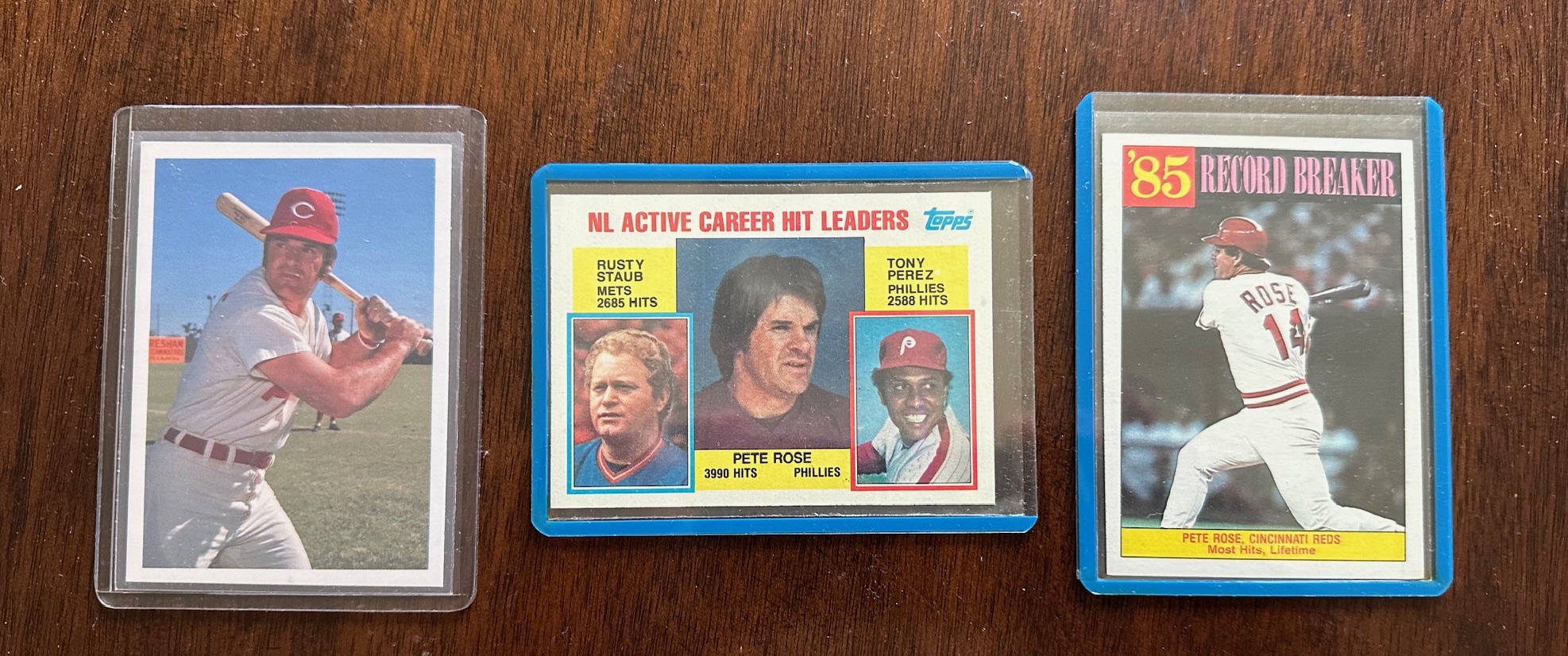
The first baseball cards that I remember getting were the Kellogg's 3-D Super Stars cards. I still have both Pete Rose cards from that series that I got as a kid:


The captions to those cards are poignant in retrospect. 

The first card's caption declares, "The NL leader in hits, runs, and doubles last year, Pete's 11th .300 season and his eighth with 200 hits enabled the Cincy superstar to continue his ascent to Cooperstown fame."

The second card's caption describes Rose's quest to break Cobb's all-time hits record and asserts, "No one, of course, is betting against 'Charlie Hustle.'"

I met Pete Rose at the 2004 National Sports Collectors Convention, which I attended with a press credential so that I could interview basketball legends (including Dolph Schayes). What does one say as an adult upon meeting a childhood sports hero who did so much for baseball but also has been exiled from baseball for breaking the sport's cardinal rule? I walked up to Rose, shook his hand, and thanked him for all of the joy I felt watching him play. He looked me in the eye, and said, "You're welcome." Unlike Jim Gray, I did not feel the need to corner Rose and demand that he answer for his past lapses. Rose gave so much to the sport of baseball and its fans, and he suffered the pain of baseball exile until his last day on Earth.

Rest in peace, Pete--and thanks for the joyful childhood memories!

Monday, January 31, 2022

Former MLB Player Doug Glanville Explains Why Barry Bonds and the Other PED Cheaters Should Never be Elected to the Baseball Hall of Fame

I recently articulated my position regarding why PED cheaters should not be elected to the Baseball Hall of Fame. I rarely provide links to ESPN.com, for reasons that should be obvious, but once in a while the site provides a gem. Former MLB player Doug Glanville offered a passionate and well-reasoned argument about why he is OK with Barry Bonds not being elected to the Hall of Fame.

Glanville makes a great point while refuting the notion that not electing Barry Bonds and the other PED cheaters is wrong because the Baseball Hall of Fame is a history museum: the story of PED cheating can be thoroughly told without electing Bonds and the other cheaters, because there is a difference between telling history and honoring people who behaved poorly. Of course the history of the PED era should be told: instead of inducting Commissioner Bud Selig--perhaps the worst commissioner in major North American sports in the past several decades--he should have towered over the PED exhibit as the poster boy of ineffective leadership that permitted the cheaters to damage the game and destroy baseball's record book, which should now only be shelved in the fiction section of libraries and bookstores.

The whole article is worth reading (just mute the speakers on your device to spare yourself the agony of hearing "Screamin' A" Smith yelling that Barry Bonds should be elected to the Baseball Hall of Fame--to find one "diamond" on ESPN.com you must traverse a lot of "rough"), but here are some excerpts to whet your appetite:

The most common argument for the inclusion of PED users in the Hall is that we can't ignore the past, and trust me--I hold no rose-colored glasses to the idealism of this game's origins. Throughout my playing career, I was always acutely aware that players who looked like me once could not even participate in that history. And yes, there are likely players who are in the Hall now who took PEDs and got away with it. Yes, there are players in the Hall who took amphetamines, whose behavior would not have lived up to the policies today. But why should any of that stop us from being better now?

We all accept that the Hall of Fame is a museum, tasked with telling the full story. But it is also a shrine. There should be a difference between being recognized in the Hall of Fame and being honored by it. I am represented in the Baseball Hall of Fame--or at least, my senior thesis from college is. Does that mean that I am a Hall of Famer? I doubt my .277 batting average and 59 home runs would have gotten me in. And I am fine with that.

I don't see why this distinction cannot be made who took PEDs and also had a record-setting impact. If we want to recognize PED users in the Hall, we can build them an exhibit, or even their own wing. We should acknowledge all of our history, both glorious and ugly. Like I am, with my paper, they can be in the Hall--as a fixture and as a recognition of their accomplishments. But I don't see why they need a plaque.

What we celebrate--what we enshrine--should have a different set of criteria. We cannot treat induction into the Hall as simply an act of historical graduation--automatic entry into the Hall because the numbers are in record books--especially when the inductees did not stand on the shoulders of their predecessors so much as trample them into the ground with glee...

With some of these players, their proponents make the argument that they would have been Hall of Famers whether or not they used. I have always been skeptical that anyone could know for sure when or if a player started taking PEDs. But more importantly, when you make a choice that artificially manipulates your performance and your future, it colors your past. Fairly or not.

We simply can't say what these enhanced players would do or be without the stuff. I was drafted in 1991, one pick in front of Manny Ramirez, a player some call the "greatest right-handed hitter of all time." Maybe he was; maybe he deserved to be drafted ahead of me. But I did not fail two tests and miss 150 games because of it. I do not know what kind of hitter he would have been without what he took. No one does. So talking about picking me over Ramirez is like comparing apples to oranges. We weren't even playing the same sport in the end. Good for him--he made his money, he won world championships. But does he need to be enshrined as an example of the best of our sport? The answer to that question is really up to us...

Nearly a decade ago, I worked on a task force with the United States Anti-Doping Agency. I was helping to evaluate a report on youth sports to understand what gives young people the fullest, healthiest and most enjoyable experience when participating in sport. Also in the group was an ethicist by the name of Tom Murray, and he said something that stuck with me: "You reward what you value."

If we are to reward players with induction into the Hall, it should be based on our values. We are the ones who need to decide the difference between being great and being consequential.

Wednesday, January 26, 2022

Baseball Hall of Fame Voters Correctly Shut the Door on Bonds and Clemens, but Give a Pass to Ortiz

In Hall of Fame balloting conducted among members of the Baseball Writers Association of America, David Ortiz received 77.9 percent of the votes, surpassing the 75 percent threshold for induction. Although Ortiz is the only player selected by the media, he will not be the only inductee this summer. He will be joined by six players who were selected by various Hall of Fame committees: Gil Hodges, Tony Oliva, Minnie Minoso, Jim Kaat, Bud Fowler, and Buck O'Neil. Kaat, Oliva, and Ortiz are the only 2022 inductees who are alive.

Ortiz ranks 17th on MLB's regular season home run list, his teams won three World Series championships (2004, 2007, 2013), and he won the 2013 World Series MVP. He is a first ballot inductee, but barely. Why did he not receive more votes? One reason is that he spent most of his career as a designated hitter, and Hall of Fame voters have typically passed on players who spent most of their careers as a designated hitter (with a few notable exceptions, including--most recently--Edgar Martinez, inducted in 2019). 

The other reason is that it is likely, but not definitively proven, that Ortiz used performance-enhancing drugs (PEDs) during his career.

In a recent article, Sports Illustrated's Tom Verducci noted that prior to 1996 there had never been an MLB season in which 12 players each hit at least 40 home runs. Then, at least 12 players each hit 40 home runs for six straight years. Verducci's 2002 SI story about rampant steroid use in MLB shamed Congress into action, and led to MLB taking the first tentative steps to test players and assess the problem. Ever since MLB began testing, there has never been another season in which at least 12 players each hit 40 or more home runs; the bloated home run numbers are tainted and, as I wrote in 2009, MLB's record book should be shelved in the fiction section.

Here are a couple player quotes from Verducci's 2002 article:

Pitcher Matt Herges declared, "I know what steroids did for me. It made me superhuman. It made me an android, basically. Your body shuts down and the stuff takes over."

Pitcher Dan Naulty said, "I was a full blown cheater and I knew it. You didn't need a written rule. I was violating clear principles that were laid down within the rules."

PEDs are called "performance-enhancing" because they enhance performance: they help pitchers throw faster and harder, and they help batters swing faster and harder. "Stat gurus" have trouble grasping this basic concept, but anyone with common sense understands why the players cheated, and anyone whose moral compass is functioning understands why the cheaters should not be inducted in the Baseball Hall of Fame. In 2012 Mark McGwire--who spent a long time evading the topic but eventually admitted that he used steroids--said, "It's a mistake that I have to live with for the rest of my life. I have to deal with never, ever getting into the Hall of Fame. I totally understand and totally respect their opinion and I will never, ever push it."

Ortiz tested positive for PEDs in 2003, though those test results did not become public knowledge until 2009. Ortiz was not productive during the early portion of his career, but he turned things around after he was released by the Minnesota Twins in 2002. At that time, he was 26 years old, and he had never hit more than 20 home runs in a season, nor had he ever slugged more than 75 RBI in a season. In 2003, the year that Ortiz tested positive, he had 31 home runs and 101 RBI in his first season with the Boston Red Sox. In 2004, Ortiz had 41 home runs and 139 RBI, followed by 47/148 and 54/137 in 2005 and 2006. MLB's PED testing program began during the 2006 season (the 2003 tests were "survey" tests to assess the extent of the problem, with the results not publicized, and with no players being disciplined even though steroids were and are illegal without a prescription). A player who stopped taking PEDs that season would be able to pass drug tests but still likely benefit from the residual effects and the muscle mass already built. Ortiz was just 30 years old, and he played 10 more years until he was 40, but he never hit more than 40 home runs in a season, though he was very productive even at age 40 (38 home runs, 127 RBI). It must be emphasized that Ortiz' production after PED testing was implemented does not prove that he was clean: it may be possible to cycle usage in a way to avoid detection, and--even more to the point--research has shown that even brief PED use can confer long-term strength gains.

So, the facts that we know are that Ortiz was a mediocre player at best until he was 26, he suddenly became good around the same time that he tested positive for PEDs, PEDs can provide a long-term advantage even after usage is discontinued, and neither Ortiz nor anyone else has provided a public explanation for Ortiz' positive test. It is not surprising that MLB, not wanting to have yet another star tainted, has stood behind Ortiz, because the evidence against him is easier to sweep under the rug than the massive evidence against Roger Clemens, Barry Bonds, Mark McGwire, Sammy Sosa, Alex Rodriguez, Manny Ramirez, Rafael Palmeiro, and many other players. It is worth mentioning that Ramirez and Ortiz were teammates on two World Series championship teams. Like Ortiz, Ramirez tested positive in 2003; Ramirez also tested positive a second time after MLB instituted penalties for positive tests, and he was suspended for 50 games during the 2009 season. MLB loves to publicize how the Red Sox overcame the "curse" to win three World Series, but the fact that the team's two best sluggers both tested positive for PEDs is brushed under the carpet (Ramirez played for the 2004 and 2007 championship teams, while Ortiz played for all three championship teams).

Verducci, who is a Hall of Fame voter, voted for Ortiz, as he does not believe that one failed test whose results were not supposed to be publicly released should disqualify Ortiz. I respect Verducci--one of the best baseball writers of all-time--but I respectfully disagree. You can be convicted in court based on circumstantial evidence, and I think that the circumstantial evidence cited above is sufficient to keep Ortiz out of the Hall of Fame, or to at least delay voting for him unless/until he is more forthcoming about his positive test.

Bonds and Clemens finished second and third in the 2022 voting. This was the final year on the ballot for both of them. Alex Rodriguez finished 10th in the 2022 voting. MLB suspended Rodriguez for the entire 2014 regular season and the entire 2014 postseason not only for using PEDs but for actively obstructing MLB's investigation of his illegal conduct. He should have been banned from the sport for life, not invited back to become a highly paid MLB analyst. Manny Ramirez finished 12th in the 2022 voting, while Sosa finished 14th.

Curt Schilling not only was not tainted by PED use, but while the PED usage was at its highest he was an outspoken critic of players who cheated by using illegal drugs. Schilling did more than enough to earn induction, but many media members do not like him because of various opinions that he has expressed, and thus Schilling only finished fifth in the balloting in his final year of eligibility. In case you forgot, never knew, or are too young to remember, Schilling posted an 11-2 postseason record, including 5-0 in elimination games. His .846 postseason winning percentage is the all-time record for pitchers with at least 10 postseason decisions. He played for three World Series champions (2001, 2004, 2007), and he won the 2001 World Series MVP. Four pitchers in MLB history have struck out 300 or more batters in a season at least three times: Sandy Koufax, Nolan Ryan, and Randy Johnson. Schilling is the only one of the four who has not been inducted in the Hall of Fame. Schilling won 216 regular season games, with a .597 winning percentage. He is one of 19 members of the 3000 strikeout club, and he has the best strikeout to walk ratio in that elite club. 

Let me be perfectly clear: I did not root for Schilling or his teams, and I disagree with some things that he has said and done. Whether you like a person or agree with a person has nothing to do with that person's qualifications to be a Hall of Famer; I understand that, but many biased media members who have been given the privilege of filling out a Hall of Fame ballot fail to understand that.

It must be noted that the PED cheaters not only caused damage during their own era, but the artificially inflated home run numbers of Bonds, McGwire, and others made it even more difficult for clean sluggers from previous eras to be inducted. Dale Murphy should have made the Hall of Fame a long time ago, but his career numbers--including 398 home runs--now look pedestrian alongside the counterfeit numbers posted by the cheaters. Murphy won back to back National League MVPs (1982-83) while leading the league in RBI during both of those seasons, and then he led the NL in home runs in 1984 and 1985 while earning two more top 10 MVP finishes. He smashed a career-high 44 home runs in 1987 during a run of nine straight seasons during which he hit at least 20 home runs (he had 36 or more home runs in five of those seasons). A 20 home run season may not seem impressive after the fake pyrotechnics of McGwire-Sosa-Bonds and the other cheaters, but Murphy finished in the NL's top four in home runs seven times, including six top three finishes. Murphy not only won four Silver Slugger awards but he also earned five Gold Gloves. He was a complete player who did things the right way, and he has been unjustly forgotten by history and by the Hall of Fame voters.

Players who fail to be elected after 10 years on the ballot can still become Hall of Famers if they are selected by a committee comprised of executives, players, and media members. As mentioned above regarding the 2022 inductees, often that recognition does not happen until after the player has died.

Bonds came within 10 percent of the vote of receiving Hall of Fame induction this year. Pete Rose, the all-time hit king who played for three World Series championship teams, never appeared on the ballot, and it does not seem likely that his candidacy will receive serious consideration during his lifetime. After Rose accepted a lifetime ban from MLB because of his gambling, the Baseball Hall of Fame created a rule making Rose ineligible to appear on the ballot, and later the Hall created a rule making him ineligible for consideration by the Veterans Committee.

All of the major sports leagues--including MLB--now reap major profits from partnerships with gambling entities, but Rose is still stuck in permanent pariah status. 

It is ridiculous that Bud Selig--perhaps the worst commissioner of a major sports league in my lifetime, if not longer--has been inducted in the Baseball Hall of Fame while Rose, Murphy, and Schilling have not been inducted. 

I hope that Rose, Murphy, and Schilling are elected as soon as possible, and I just as fervently hope that the Baseball Hall of Fame never opens its hallowed doors to the PED cheaters who permanently stained the sport.

Tuesday, December 15, 2015

Pete Rose Does not Belong Back in Baseball but He Belongs in the Baseball Hall of Fame

Pete Rose broke Major League Baseball's fundamental rule about gambling on the sport and he lied about breaking that rule. He deserved to receive a harsh punishment and he has received a harsh punishment: Rose accepted a lifetime ban in 1989. That ban came with a proviso enabling Rose to apply to the MLB Commissioner for reinstatement after one year but now that Rob Manfred has become the third consecutive MLB Commissioner to reject Rose's application for reinstatement it appears that Rose's lifetime ban will most likely never be lifted.

It is understandable why MLB refuses to let Rose have an active role in the sport as an executive, field manager or instructor. Rose continues to bet on sports--including baseball--and even though Rose now apparently does his gambling legally he has failed to "reconfigure his life," which was the standard imposed upon him in order to be reinstated. If Rose were not a compulsive gambler and/or a very stubborn/defiant person then he would have stopped gambling completely and stopped associating himself with casinos. Rose's complaint that this is the only way he can support himself after being banned from baseball does not hold water; Rose remains an immensely popular figure who does not need to be involved with gambling in order to support himself.

If Rose were permitted to work in baseball this would not only reduce the deterrence value of the lifetime ban but it would also potentially create huge problems; Rose clearly cannot stop gambling and if he has access to insider knowledge about baseball players and teams then the possibilities for fixing games (or simply having an unfair advantage as a wagerer) are huge. That is not to say that Rose ever fixed a game or that he would fix a game now but it is understandable that MLB does not want to take such a risk with a compulsive gambler who is also a serial liar.

Rose would have a lot to offer to the sport if he had not chosen this life path but he has to suffer the natural consequences of his mistakes. Rose's exile from the sport he loves is tragic but it is a self-imposed tragedy and it is a tragedy that he could have mitigated over the past few decades if he had made some sincere efforts to "reconfigure his life." Rose reminds me of an alcoholic who says "I can stop drinking whenever I want" but refuses to stop drinking even if the alcohol consumption could harm the alcoholic and/or others. Rose needs intensive therapy/treatment to control his gambling addiction and he has never sought out that help; that is his prerogative and if all of his gambling activities now are legal then no one has the legal authority to stop him but MLB provided Rose with a standard for reinstatement--life reconfiguration--and Rose has failed to meet that standard.

However, Rose's eligibility for Hall of Fame induction should be restored. When Rose agreed to accept the lifetime ban with the possibility of applying for reinstatement, he did not forfeit his eligibility for Baseball Hall of Fame induction. Rose became ineligible for the Baseball Hall of Fame on February 4, 1991, when the Baseball Hall of Fame passed a rule prohibiting anyone who is on MLB's permanently ineligible list from being inducted in the Baseball Hall of Fame. Rose is the only living person on the permanently ineligible list, which means that the rule was passed purely to exclude him (it may theoretically exclude other people in the future but he is the only living person affected by the rule now). Without this new rule, Rose would have appeared on the Baseball Writers Association of America Hall of Fame ballot from 1992-2006. The writers could have studied the evidence at their leisure and made their own determination about whether or not Rose belongs in the Baseball Hall of Fame. Clearly, based on the merits of his skills and accomplishments, Rose would be a first ballot Hall of Famer. A case could be made that based on character he should be excluded--but the writers should at least have been given the opportunity to pass judgment and to consider that judgment over a 15 year period (assuming that Rose did not make it in immediately).

The Veterans Committee examines the Hall of Fame candidacies of any eligible candidate for the Baseball Hall of Fame who is not selected after being on the BBWAA ballot but in 2008 the Veterans Committee passed a rule barring anyone from the permanently ineligible list from being considered for Hall of Fame induction. Again, this is a rule that primarily if not exclusively affects Rose.

I understand the argument that Rose's character flaws should keep him out of the Baseball Hall of Fame. I have made it clear that MLB's PED cheaters should not be inducted in the Hall of Fame because they have defiled MLB's record book. What Rose did is terrible and the way that he denied his conduct for years before begrudgingly making some admissions says a lot about Rose's character but the difference between Rose and the PED cheaters is that there is no evidence that Rose's gambling impacted the quality of his play or defiled the sport's record book. Rose should be placed on the Baseball Hall of Fame ballot and if he is voted in then his plaque should not only list his pertinent accomplishments but also state that in 1989 he was placed on the permanently ineligible list because he bet on baseball. Unless or until there is evidence that Rose's playing career/statistics are tainted by his gambling Rose deserves at least the opportunity to be selected as a Baseball Hall of Famer. The lifetime ban from the sport shields MLB from any damage that Rose's compulsive gambling could cause now and punishes him in a way that will hopefully deter others from making the mistakes that he did.

Monday, July 28, 2014

Frank Thomas Did it the Right Way

PED users defiled MLB's record book but some statistics and records still matter; it is important to recognize and honor the select group of great players who battled temptation--and went head to head physically with players who used illegal drugs to obtain a competitive advantage--during MLB's "Steroid Era". Frank Thomas not only stayed clean during his outstanding 19 year MLB career but he never hesitated to speak out against the cheaters, even when it was unpopular to do so. After Thomas hit his 500th career home run, I explained that Thomas had rightfully earned Hall of Fame status even before that signature blast.

Thomas finished his career with a .301 batting average, a .419 on base percentage and a .555 slugging percentage. Babe Ruth is the only major leaguer with at least 10,000 plate appearances who surpassed Thomas in all three of those categories. Ruth, Hank Aaron, Jimmie Foxx and Willie Mays are the only clean players who exceeded Thomas in both batting average and career home runs (521)*. Thomas is the only player who compiled a streak of seven straight seasons with at least a .300 average, 100 walks, 100 runs, 100 RBI and 20 home runs.

The Baseball Hall of Fame voters selected Thomas in his first year of eligibility and on Sunday "The Big Hurt" joined Greg Maddux, Tom Glavine, Joe Torre, Bobby Cox and Tony LaRussa in the Hall of Fame Class of 2014. Thomas' Hall of Fame Induction Speech overflows with gratitude for the many relatives, friends, teammates and coaches who shaped his development as a man and as a baseball player. Thomas concluded with a simple, powerful statement: "To all you kids out there, just remember one thing from today. There are no shortcuts to success. Hard work, dedication, commitment, stay true to who you are. God bless you all, and I thank you."

-----
*Manny Ramirez is a PED cheater, so his statistics should be classified as "fiction."

Saturday, January 9, 2010

Hawk Finally Swoops Into Cooperstown

Andre Dawson was the ultimate five-tool player and his combination of power, speed, hitting ability, fielding prowess and a strong arm earned him the nickname "The Hawk." Dawson is the only player who received enough votes to be inducted in the Baseball Hall of Fame this year but just a glance at his resume shows that he should have glided into Cooperstown a long time ago: 1977 NL Rookie of the Year, eight time All-Star, eight time Gold Glove winner, NL MVP runner-up in 1982 when he led the Montreal Expos to their first and only playoff appearance, 1987 NL MVP in his first season with the Chicago Cubs (the first player from a last place team to win that award), 438 career home runs (36th all-time, ahead of old school Hall of Famers Billy Williams, Duke Snider and Al Kaline) and 1591 career RBI (34th all-time, just four RBI behind Hall of Famers Mike Schmidt and George Brett and seven RBI ahead of Hall of Famers Rogers Hornsby and Harmon Killebrew). Dawson's knees absorbed a terrible pounding during his early years patrolling the AstroTurf outfield for the Expos but despite injuries that robbed him of some of his mobility and caused him great pain he still totaled 314 career stolen bases, joining Willie Mays and Barry Bonds as the only players in MLB history with at least 400 career home runs plus at least 300 career stolen bases.

It is fitting to mention Bonds' name in connection with Dawson's, because it is partially Bonds' fault that Dawson had to wait so long to join the Hall of Fame; when Bonds and the other performance-enhancing drug (PED) using cheaters made a travesty of MLB's record book in the 1990s and 2000s it became easy to overlook the accomplishments of stars from the 1970s and 1980s like Dawson and Dale Murphy (a two-time NL MVP, seven time All-Star and five time Gold Glove winner who still has not been inducted in the Hall of Fame). How could players who "only" totaled 350-450 home runs be elected to the Hall of Fame when players began routinely cranking out 50-plus home run seasons en route to astronomical career totals exceeding 500 home runs? I am not interested in parsing out how many home runs Bonds, Alex Rodriguez or any other cheaters hit when they were clean--all of those guys cheated the game, cheated themselves, cheated the fans and cheated the legitimate Hall of Famers who came before them and I hope that the Hall of Fame voters reject all of them the way that Mark "I'm not here to talk about the past" McGwire has been rejected so far. The Hall should spend the next decade or so inducting every omitted player from the 1970s and 1980s and the few spotless guys from the 1990s like Ken Griffey and Frank Thomas but I hope that I never see Bonds, Rodriguez or Roger Clemens in Cooperstown. How can the Hall exclude Pete Rose as a player for conduct that he did as a manager and then induct players whose actions tainted the sport's history and records?

The sad postscript to Dawson's election to the Hall of Fame is that the honor came three years after his mother passed away--but at least Dawson can be somewhat comforted by the fact that Mattie Brown, like any good mother, never doubted her son's talent or his place in history, telling him "Baby, it's gonna happen. Don't worry about it. Just be patient. You did what you did for a long time. The Hall of Fame, they can prolong your entry but they won't take it away from you."

Monday, July 28, 2008

Gossage is Finally a HoFer but the Hall Still Refuses to Properly Honor Buck O'Neil

On Sunday, the Baseball Hall of Fame welcomed six new members: Barney Dreyfuss (Pirates owner who helped create the World Series), Bowie Kuhn (MLB Commissioner, 1969-84), Walter O'Malley (Dodgers owner whose team won four World Series championships and 11 NL pennants), Billy Southworth (St. Louis manager won two World Series championships), Dick Williams (Oakland manager won two World Series championships, later became second skipper to guide three different franchises to the World Series) and ace reliever Rich "Goose" Gossage, who finally received this much overdue honor. As Tom Paciorek once said after facing Gossage in his prime, "You need a cape to face Gossage, not a baseball bat."

It took the voters nine times to do something that they should have done as soon as Gossage became eligible. I've never understood the Byzantine set of unwritten rules that govern Hall of Fame elections, particularly with baseball but in other sports as well: certain guys are deemed worthy but not "first ballot worthy," other players receive virtually no consideration initially but then their candidacies mysteriously gain ground over the years even though their statistics have obviously not changed and other people who clearly belong in the Hall simply never receive enough votes. In this context it must also be mentioned that the Baseball Hall of Fame changed its rules after Pete Rose's lifetime ban specifically to keep Rose--a first ballot Hall of Famer if there ever was one--out of a shrine that is filled with mementos denoting his numerous achievements (people on MLB's banned list were not barred from being on the HoF ballot until after MLB Commissioner Bart Giamatti excommunicated Rose from the sport).

I could document all the reasons that Gossage should have been inducted nearly a decade ago but the great William Nack--longtime writer for Sports Illustrated--beat me to it with a wonderfully descriptive ESPN.com article that is based on some firsthand reporting that Nack did during Gossage's prime. You really should read the entire thing but here is a taste to whet your appetite:

"No pitcher in the modern era brought a more palpable aura of menace to his work. At 6-foot-3 and 220 pounds, drooping handlebar mustache and all, his eyes as big as pie tins, Gossage would turn his back to batters as he wound up--actually facing toward left field and showing them his number--then explode towards home plate in a tangle of arms and legs, like a man falling out of a tree, hiding the ball until it finally came spinning out of the pinstriped blur. It's no surprise many opposing hitters would wonder, does he have any idea where this pitch is going? And then, discreetly, step to the back of the batter's box."

On October 2, 1978, Gossage's New York Yankees faced the Boston Red Sox in a one game playoff to decide the AL East title. The Yankees led 4-3 in the bottom of the ninth. There were two outs and two men on base when another Hall of Famer, Carl Yastrzemski, stepped into the batter's box to face Gossage, who had literally dreamed about such a matchup: "I went to bed the night before thinking about coming into the game, and I thought I might be facing Yaz with the game on the line. I thought about facing him because he was such a great clutch hitter...It might have been the biggest game of my life."

Gossage induced Yaz to pop up and Nack, who was seated behind home plate, vividly describes the scene: "That they could preserve that moment, in a diorama under glass, in some small corner at Cooperstown--the roaring crowd going instantly silent, as if cut off by a switch. Nearly 33,000 horrified faces looking up, all mouths open. The ball seeming to rise forever, hanging like a blue moon over Fenway, before plunging like an arrow into the heart of...Graig Nettles' glove."

Nack recounts that Gossage was so unhittable that sometimes his catcher would not even try to hide the signs, blatantly letting the batter know that a fastball was coming. It wasn't like there was anything anybody could do about it; Gossage sometimes struck out the side on just 10 or 11 pitches. Closers often work just one inning now but 193 of Gossage's 310 career saves required more than three outs. Nack concludes, "Of the big closers who preceded him to the Hall, including Rollie Fingers (341 saves) and Bruce Sutter (300 saves), Gossage was by far the most fearsome and intimidating, the guy you'd really want facing Yaz in the bottom of the ninth."

At least Gossage finally has been inducted and he lived long enough to enjoy this special day; the great Buck O'Neil passed away and the Hall still has not rectified the injustice that it did to him. O'Neil played 12 seasons in the Negro Leagues and also won multiple Negro League championships as a manager. Statistics from that era are not always reliable but if there was any question about whether his playing credentials earned him induction in the Hall of Fame then his decades-long service as a great ambassador for the sport--including his pivotal role in the creation of the Negro Leagues Baseball Museum in Kansas City--should have sealed the deal without question. He played an instrumental role in prodding the Hall of Fame to grant induction to many Negro Leaguers whose achievements had been neglected for decades but in a sad and twisted irony O'Neil fell short of the required votes when he was placed on a special Negro League Hall of Fame ballot in 2006. If this unjustified slight made the then-94 year old bitter he did not let those feelings show publicly, declaring, "God's been good to me. They didn't think Buck was good enough to be in the Hall of Fame. That's the way they thought about it and that's the way it is, so we're going to live with that. Now, if I'm a Hall of Famer for you, that's all right with me. Just keep loving old Buck. Don't weep for Buck. No, man, be happy, be thankful." The Hall invited O'Neil to introduce the new Negro League Hall of Famers at the 2006 induction ceremony that should have been a crowning honor for him. Many people would have told the Hall exactly where to stick that invitation but O'Neil came there and stole the show. He passed away just a few months later.

It is obvious that O'Neil should have been inducted in the Hall of Fame but the Hall cannot seem to bring itself to correct this error; instead, after O'Neil's death the Hall built a statue of O'Neil to be placed in the Negro Leagues Baseball Museum and created a Buck O'Neil Lifetime Achievement Award. The first winner is none other than O'Neil himself. I can't recall another example of an award being created to honor the person for which it is named but I guess this is the Hall's way of admitting it messed up without actually admitting it messed up.