"I'd walk through hell in a gasoline suit to play baseball"--Pete Rose
The best, worst, and most accurate thing that you can say about Pete Rose is that he did it his way. Peter Edward Rose--also known as "Charlie Hustle" and "The Hit King," but forever known as "Pete" to his adoring fans--passed away on Monday at the age of 83. During a 24 year career spent mainly with the Cincinnati Reds and also including time with the Philadelphia Phillies (1979-83) and Montreal Expos (1984), Rose set many MLB records, but none are more impressive or meaningful than the career hits record; Rose bashed 4256 hits, eclipsing a Ty Cobb mark that stood for over 50 years. A player averaging 200 hits per season for 20 years would not match what Rose accomplished, so it is fair to suggest that Rose--who has been "The Hit King" since 1985--will remain number one for a long time.
Other MLB records held by Rose include being the only player to play at least 500 games at five different positions (first baseman, second baseman, third baseman, right fielder, and left fielder), most seasons with 150 or more games played (17), most seasons with 100 or more games played (23), most career runs by a switch hitter (2165), most career doubles by a switch hitter (746), most consecutive seasons with at least 100 hits (23), and most seasons with at least 200 hits (10, a mark shared with Ichiro Suzuki). A popular catchphrase declares "Chicks dig the long ball," but Rose did it his way without being a home run slugger, and he achieved his goal of becoming the first $100,000 singles hitter at a time when making $100,000 a year as a baseball player was a rare feat.
Rose participated in 1972 MLB games that his team won, a record that is unlikely to ever be approached. Rose was fond of pointing out that he won more games than the total number of games played by the legendary Joe Dimaggio (1736)!
Rose holds the NL marks for most years played (24), most career runs
(2165), most career doubles (746), and most career games with at least
five hits (10). The Cincinnati Reds Record Book could be renamed "The Pete Rose Story," as Rose is the franchise's career leader in games (2722), plate appearances (12,344), runs (1741), hits (3358), singles (2490), doubles (601), and walks (1210). Reds' principal owner and managing partner Bob Castellini said, "Our hearts are deeply saddened by the news of Pete's passing. He was one of the fiercest competitors the game has ever seen, and every team he played for was better because of him. Pete was a Red through and through. No one loved the game more than Pete and no one loved Pete more than Reds Country. We must never forget what he accomplished."
Not only did Rose make the All-Star team 17 times, he is the only player in MLB history to be selected as an All-Star at five different positions: second baseman, left fielder, right fielder, third baseman, and first baseman. In Rose's era, the All-Star Game was not treated as an insignificant exhibition game but rather as a highly competitive battle between the National League and the American League. Perhaps no player took that spirit of competition as seriously as Rose, as exemplified by the famous (or infamous, depending on your perspective) play at home plate in the 1970 MLB All-Star Game when Rose bowled over catcher Ray Fosse to score the winning run in the bottom of the 12th inning. Fosse injured his shoulder on the play and was never fully healthy again. Asked about the play years later, Rose regretted that Fosse got hurt but did not regret his action, stating that playing all out is the only way to play the game. That was the NL's eighth straight All-Star Game win and, after losing in 1971, the NL won the next 11 All-Star Games.
Rose won the 1975 World Series MVP, the 1973 NL regular season MVP, the 1963 NL Rookie of the Year award, and three NL batting titles (1968-69, 1973). He won two Gold Gloves (1969-70), and when he retired in 1986 he not only had the highest MLB career fielding percentage for a right fielder but he also had the highest NL career fielding percentage for a left fielder.
In 1978, Rose's 44 game hitting streak electrified baseball fans, and it is still the third
longest such streak in MLB history. I am too young to have clear
memories of the Big Red Machine's 1975-76 glory days, but I remember
Rose's hitting streak being much discussed on TV and radio during the summer of 1978, and I recall
the daily updates in local newspapers.
Rose's teams went 9-5 in postseason series as he hit .321, including .370 in the 1975 World Series. Rose's teams won three World Series titles (1975-76 with his hometown Cincinnati
Reds, 1980 with the Philadelphia Phillies). The 1976 Reds are the only team in MLB's two round playoff era (1969-93) to go undefeated, sweeping first the Philadelphia Phillies and then the New York Yankees. Rose was an integral member of the powerful Big Red Machine teams that reached the World Series four times (1970, 1972, 1975-76) in a seven season span.
Rose helped the Phillies win their first World Series title after they fell short in three straight NLCS losses (1976-78) prior to his 1979 arrival in Philadelphia. Hall of Fame third baseman Mike Schmidt enjoyed some of his finest moments--including winning his only World Series and capturing two of his three NL regular season MVPs (1980-81)--as Rose's Philadelphia teammate. Schmidt issued this statement after Rose's passing: "My heart goes out to his family. I was lucky that I got to play with Pete and to watch him every day. As a teammate, he boosted my confidence, he made me laugh and kept me loose. He taught me to enjoy the game, perhaps advice that I needed the most."
The negative side of Rose doing things his way involved illegal gambling, culminating in betting on baseball games while he served as the Reds' manager from 1984-89 (including a stint as MLB's last player-manager from 1984-86). Despite a mountain of evidence stacked against him, Rose adamantly denied betting on baseball until he admitted the truth in 2004. Nevertheless, he accepted a lifetime ban from MLB in 1989 with an option to seek reinstatement. It must be emphasized that the lifetime ban barred Rose from participating in MLB in any capacity but DID NOT prevent the writers from voting him into the Baseball Hall of Fame should they choose to do so after he became eligible; a 1991 ruling by the Baseball Hall of Fame board rendered Rose ineligible to be elected, taking the decision out of the hands of the baseball writers. In 2008, the Baseball Hall of Fame's Veterans Committee passed a similar rule. Both rules primarily--if not exclusively--target Rose. I analyzed this topic at length in 2015, and I concluded that it is wrong to keep Rose off of the Hall of Fame ballot:
I understand the argument that Rose's character flaws should keep him out of the Baseball Hall of Fame. I have made it clear that MLB's PED cheaters should not be inducted in the Hall of Fame because they have defiled MLB's record book. What Rose did is terrible and the way that he denied his conduct for years before begrudgingly making some admissions says a lot about Rose's character but the difference between Rose and the PED cheaters is that there is no evidence that Rose's gambling impacted the quality of his play or defiled the sport's record book. Rose should be placed on the Baseball Hall of Fame ballot and if he is voted in then his plaque should not only list his pertinent accomplishments but also state that in 1989 he was placed on the permanently ineligible list because he bet on baseball. Unless or until there is evidence that Rose's playing career/statistics are tainted by his gambling Rose deserves at least the opportunity to be selected as a Baseball Hall of Famer. The lifetime ban from the sport shields MLB from any damage that Rose's compulsive gambling could cause now and punishes him in a way that will hopefully deter others from making the mistakes that he did.
The argument in favor of Rose's Hall of Fame candidacy is bolstered by the fact that MLB--like most other major sports leagues--has now fully embraced and profited from sponsorship deals directly connected with promoting gambling, in marked contrast to the decades-long notion that any affiliation with wagering would taint sports. That cultural shift does not justify Rose's conduct--he broke the rule in place at that time, and that rule is still in place now--but it is hypocritical for MLB to profit from promoting gambling while taking such an unforgiving stance toward the "Hit King," and I reiterate my position that Rose should be made eligible for Hall of Fame induction.
Despite MLB's lifetime ban, Rose was selected to MLB's All-Century Team in 1999. During the on field ceremony, reporter Jim Gray--acting as if he were a candidate for a prize in investigative reporting--grilled Rose on national TV about the gambling scandal. Rose, like most of the audience, was surprised that Gray pursued that line of questioning at that moment. There is a proper time and place for everything, and that was neither the proper time or place. Rose deserved to celebrate that moment without being interrogated and humiliated.
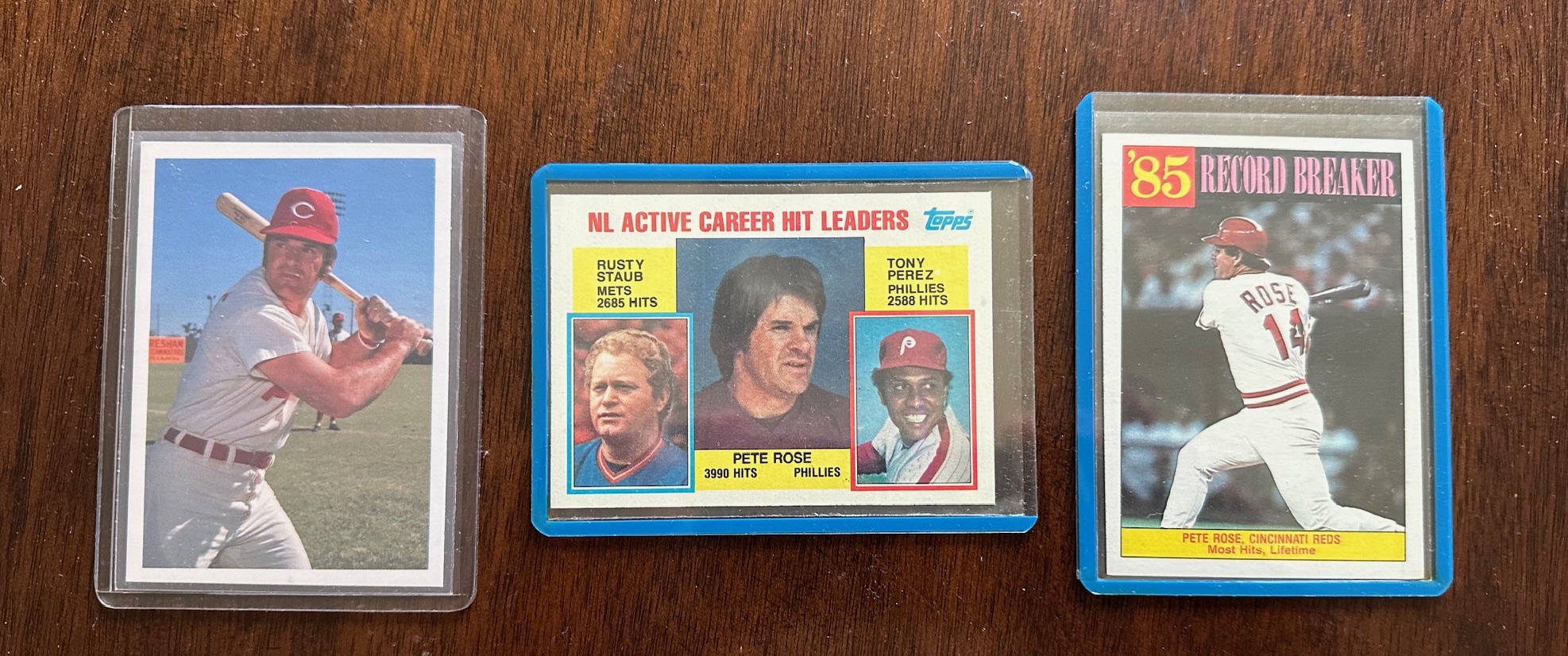
Earlier in 1999, The Sporting News ranked Rose as the 25th greatest baseball player of all-time. His place in baseball history is secure, with or without his deserved Hall of Fame induction. Pete Rose was a flawed human--as we all are--but he set a great example on the field by playing hard and playing to win. I vividly remember the second half of his playing career, and it was a joy to watch him play. For a kid in the 1960s-1980s, it was a delight to pull a Pete Rose baseball card from a pack or to find a Pete Rose baseball card in a hobby shop. Here are three of my Pete Rose baseball cards:
The first baseball cards that I remember getting were the Kellogg's 3-D Super Stars cards. I still have both Pete Rose cards from that series that I got as a kid:


The captions to those cards are poignant in retrospect.
The first card's caption declares, "The NL leader in hits, runs, and doubles last year, Pete's 11th .300 season and his eighth with 200 hits enabled the Cincy superstar to continue his ascent to Cooperstown fame."
The second card's caption describes Rose's quest to break Cobb's all-time hits record and asserts, "No one, of course, is betting against 'Charlie Hustle.'"
I met Pete Rose at the 2004 National Sports Collectors Convention, which I attended with a press credential so that I could interview basketball legends (including Dolph Schayes). What does one say as an adult upon meeting a childhood sports hero who did so much for baseball but also has been exiled from baseball for breaking the sport's cardinal rule? I walked up to Rose, shook his hand, and thanked him for all of the joy I felt watching him play. He looked me in the eye, and said, "You're welcome." Unlike Jim Gray, I did not feel the need to corner Rose and demand that he answer for his past lapses. Rose gave so much to the sport of baseball and its fans, and he suffered the pain of baseball exile until his last day on Earth.
Rest in peace, Pete--and thanks for the joyful childhood memories!