Showing posts with label MLB. Show all posts

Wednesday, October 2, 2024

Remembering Pete Rose, "The Hit King"

"I'd walk through hell in a gasoline suit to play baseball"--Pete Rose

The best, worst, and most accurate thing that you can say about Pete Rose is that he did it his way. Peter Edward Rose--also known as "Charlie Hustle" and "The Hit King," but forever known as "Pete" to his adoring fans--passed away on Monday at the age of 83. During a 24 year career spent mainly with the Cincinnati Reds and also including time with the Philadelphia Phillies (1979-83) and Montreal Expos (1984), Rose set many MLB records, but none are more impressive or meaningful than the career hits record; Rose bashed 4256 hits, eclipsing a Ty Cobb mark that stood for over 50 years. A player averaging 200 hits per season for 20 years would not match what Rose accomplished, so it is fair to suggest that Rose--who has been "The Hit King" since 1985--will remain number one for a long time.

Other MLB records held by Rose include being the only player to play at least 500 games at five different positions (first baseman, second baseman, third baseman, right fielder, and left fielder), most seasons with 150 or more games played (17), most seasons with 100 or more games played (23), most career runs by a switch hitter (2165), most career doubles by a switch hitter (746), most consecutive seasons with at least 100 hits (23), and most seasons with at least 200 hits (10, a mark shared with Ichiro Suzuki). A popular catchphrase declares "Chicks dig the long ball," but Rose did it his way without being a home run slugger, and he achieved his goal of becoming the first $100,000 singles hitter at a time when making $100,000 a year as a baseball player was a rare feat.

Rose participated in 1972 MLB games that his team won, a record that is unlikely to ever be approached. Rose was fond of pointing out that he won more games than the total number of games played by the legendary Joe Dimaggio (1736)!

Rose holds the NL marks for most years played (24), most career runs (2165), most career doubles (746), and most career games with at least five hits (10). The Cincinnati Reds Record Book could be renamed "The Pete Rose Story," as Rose is the franchise's career leader in games (2722), plate appearances (12,344), runs (1741), hits (3358), singles (2490), doubles (601), and walks (1210). Reds' principal owner and managing partner Bob Castellini said, "Our hearts are deeply saddened by the news of Pete's passing. He was one of the fiercest competitors the game has ever seen, and every team he played for was better because of him. Pete was a Red through and through. No one loved the game more than Pete and no one loved Pete more than Reds Country. We must never forget what he accomplished."

Not only did Rose make the All-Star team 17 times, he is the only player in MLB history to be selected as an All-Star at five different positions: second baseman, left fielder, right fielder, third baseman, and first baseman. In Rose's era, the All-Star Game was not treated as an insignificant exhibition game but rather as a highly competitive battle between the National League and the American League. Perhaps no player took that spirit of competition as seriously as Rose, as exemplified by the famous (or infamous, depending on your perspective) play at home plate in the 1970 MLB All-Star Game when Rose bowled over catcher Ray Fosse to score the winning run in the bottom of the 12th inning. Fosse injured his shoulder on the play and was never fully healthy again. Asked about the play years later, Rose regretted that Fosse got hurt but did not regret his action, stating that playing all out is the only way to play the game. That was the NL's eighth straight All-Star Game win and, after losing in 1971, the NL won the next 11 All-Star Games.

Rose won the 1975 World Series MVP, the 1973 NL regular season MVP, the 1963 NL Rookie of the Year award, and three NL batting titles (1968-69, 1973). He won two Gold Gloves (1969-70), and when he retired in 1986 he not only had the highest MLB career fielding percentage for a right fielder but he also had the highest NL career fielding percentage for a left fielder.

In 1978, Rose's 44 game hitting streak electrified baseball fans, and it is still the third longest such streak in MLB history. I am too young to have clear memories of the Big Red Machine's 1975-76 glory days, but I remember Rose's hitting streak being much discussed on TV and radio during the summer of 1978, and I recall the daily updates in local newspapers. 

Rose's teams went 9-5 in postseason series as he hit .321, including .370 in the 1975 World Series. Rose's teams won three World Series titles (1975-76 with his hometown Cincinnati Reds, 1980 with the Philadelphia Phillies). The 1976 Reds are the only team in MLB's two round playoff era (1969-93) to go undefeated, sweeping first the Philadelphia Phillies and then the New York Yankees. Rose was an integral member of the powerful Big Red Machine teams that reached the World Series four times (1970, 1972, 1975-76) in a seven season span.

Rose helped the Phillies win their first World Series title after they fell short in three straight NLCS losses (1976-78) prior to his 1979 arrival in Philadelphia. Hall of Fame third baseman Mike Schmidt enjoyed some of his finest moments--including winning his only World Series and capturing two of his three NL regular season MVPs (1980-81)--as Rose's Philadelphia teammate. Schmidt issued this statement after Rose's passing: "My heart goes out to his family. I was lucky that I got to play with Pete and to watch him every day. As a teammate, he boosted my confidence, he made me laugh and kept me loose. He taught me to enjoy the game, perhaps advice that I needed the most."

The negative side of Rose doing things his way involved illegal gambling, culminating in betting on baseball games while he served as the Reds' manager from 1984-89 (including a stint as MLB's last player-manager from 1984-86). Despite a mountain of evidence stacked against him, Rose adamantly denied betting on baseball until he admitted the truth in 2004. Nevertheless, he accepted a lifetime ban from MLB in 1989 with an option to seek reinstatement. It must be emphasized that the lifetime ban barred Rose from participating in MLB in any capacity but DID NOT prevent the writers from voting him into the Baseball Hall of Fame should they choose to do so after he became eligible; a 1991 ruling by the Baseball Hall of Fame board rendered Rose ineligible to be elected, taking the decision out of the hands of the baseball writers. In 2008, the Baseball Hall of Fame's Veterans Committee passed a similar rule. Both rules primarily--if not exclusively--target Rose. I analyzed this topic at length in 2015, and I concluded that it is wrong to keep Rose off of the Hall of Fame ballot:

I understand the argument that Rose's character flaws should keep him out of the Baseball Hall of Fame. I have made it clear that MLB's PED cheaters should not be inducted in the Hall of Fame because they have defiled MLB's record book. What Rose did is terrible and the way that he denied his conduct for years before begrudgingly making some admissions says a lot about Rose's character but the difference between Rose and the PED cheaters is that there is no evidence that Rose's gambling impacted the quality of his play or defiled the sport's record book. Rose should be placed on the Baseball Hall of Fame ballot and if he is voted in then his plaque should not only list his pertinent accomplishments but also state that in 1989 he was placed on the permanently ineligible list because he bet on baseball. Unless or until there is evidence that Rose's playing career/statistics are tainted by his gambling Rose deserves at least the opportunity to be selected as a Baseball Hall of Famer. The lifetime ban from the sport shields MLB from any damage that Rose's compulsive gambling could cause now and punishes him in a way that will hopefully deter others from making the mistakes that he did.

The argument in favor of Rose's Hall of Fame candidacy is bolstered by the fact that MLB--like most other major sports leagues--has now fully embraced and profited from sponsorship deals directly connected with promoting gambling, in marked contrast to the decades-long notion that any affiliation with wagering would taint sports. That cultural shift does not justify Rose's conduct--he broke the rule in place at that time, and that rule is still in place now--but it is hypocritical for MLB to profit from promoting gambling while taking such an unforgiving stance toward the "Hit King," and I reiterate my position that Rose should be made eligible for Hall of Fame induction.

Despite MLB's lifetime ban, Rose was selected to MLB's All-Century Team in 1999. During the on field ceremony, reporter Jim Gray--acting as if he were a candidate for a prize in investigative reporting--grilled Rose on national TV about the gambling scandal. Rose, like most of the audience, was surprised that Gray pursued that line of questioning at that moment. There is a proper time and place for everything, and that was neither the proper time or place. Rose deserved to celebrate that moment without being interrogated and humiliated.

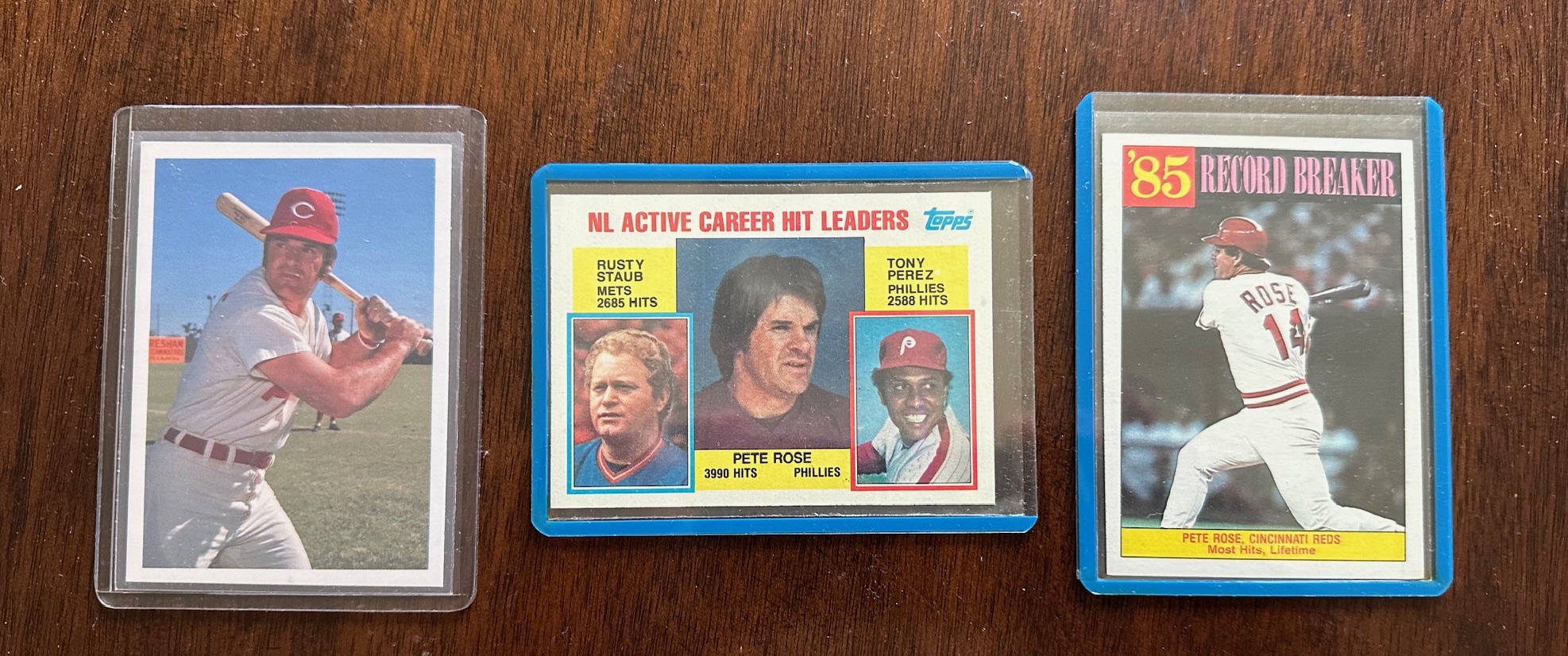
Earlier in 1999, The Sporting News ranked Rose as the 25th greatest baseball player of all-time. His place in baseball history is secure, with or without his deserved Hall of Fame induction. Pete Rose was a flawed human--as we all are--but he set a great example on the field by playing hard and playing to win. I vividly remember the second half of his playing career, and it was a joy to watch him play. For a kid in the 1960s-1980s, it was a delight to pull a Pete Rose baseball card from a pack or to find a Pete Rose baseball card in a hobby shop. Here are three of my Pete Rose baseball cards:
The first baseball cards that I remember getting were the Kellogg's 3-D Super Stars cards. I still have both Pete Rose cards from that series that I got as a kid:


The captions to those cards are poignant in retrospect. 

The first card's caption declares, "The NL leader in hits, runs, and doubles last year, Pete's 11th .300 season and his eighth with 200 hits enabled the Cincy superstar to continue his ascent to Cooperstown fame."

The second card's caption describes Rose's quest to break Cobb's all-time hits record and asserts, "No one, of course, is betting against 'Charlie Hustle.'"

I met Pete Rose at the 2004 National Sports Collectors Convention, which I attended with a press credential so that I could interview basketball legends (including Dolph Schayes). What does one say as an adult upon meeting a childhood sports hero who did so much for baseball but also has been exiled from baseball for breaking the sport's cardinal rule? I walked up to Rose, shook his hand, and thanked him for all of the joy I felt watching him play. He looked me in the eye, and said, "You're welcome." Unlike Jim Gray, I did not feel the need to corner Rose and demand that he answer for his past lapses. Rose gave so much to the sport of baseball and its fans, and he suffered the pain of baseball exile until his last day on Earth.

Rest in peace, Pete--and thanks for the joyful childhood memories!

Friday, February 17, 2023

Reflections on the Passing of Broadcasting Legend--and All-Star Catcher--Tim McCarver

It is natural and common for a sports fan to fervently insist that the golden age of sports coincides with his childhood. My earliest sports memories date back to the mid-1970s, and many of my fondest sports memories are from the 1980s. For me, the period from the mid-1970s through the late-1980s is the golden age of sports, and that time period is memorable not only because of the splendid athletes who were in their primes--including but not limited to Julius ErvingPete Maravich, George Gervin, Kareem Abdul-Jabbar, the Magic Johnson-Larry Bird-Michael Jordan triumvirate, Mario AndrettiBjorn Borg, Pete Rose, Eric Davis, Reggie Jackson, Joe Montana, Jerry Rice, Walter Payton, and Bo Jackson--but also because of the insights provided by TV analysts such as Hubie Brown, John Madden, and Tim McCarver. On the play by play side, Al Michaels, Dick Enberg, Dick Stockton, and Marv Albert were the cream of the crop.

Brown coached the Kentucky Colonels to the 1975 ABA title, Madden coached the Oakland Raiders to a win in Super Bowl XI, and McCarver played for two World Series champions in the 1960s. All three understood what it takes to win at the highest level of sport, and all three had the gift of conveying that understanding to viewers within the flow of the game. When Brown, Madden, or McCarver did an NBA, NFL, or MLB game respectively, you knew that it was a big game--and you knew that you were going to be blessed with intelligent analysis.

Brown still occasionally works NBA games for ESPN/ABC, but he has not been a lead analyst for many years. Madden passed away on December 28, 2021. McCarver passed away yesterday. Michaels now does Amazon's Thursday night NFL games and he is still excellent, if perhaps not quite at his peak. Enberg passed away in 2017. Albert and Stockton retired in 2021, though they both appeared as guests during the NBA's 75th Anniversary Celebration Game.

Intelligent sports commentary has never been plentiful, but a gaping void exists in the NBA, NFL, and MLB that may never be filled. That is not to say that there are not some very good commentators working today--but will any of the commentators who are in their primes now be considered all-time greats?

McCarver served as the national TV analyst for a record 24 World Series on three different networks (ABC, CBS, Fox). Joe Buck, McCarver's play by play partner for 18 years, said on Thursday, "I learned really fast that if you were in his inner circle, he would be a fierce defender of you and for you. He taught me how to deal with criticism because he had been criticized his whole broadcast career. And sometimes it was because he was a teacher of the game. If some player or manager didn't manage or play the way he thought the game should be played, he let a national audience know it. He was always the first one in the clubhouse the next day. If that person had something to say back to him, he would engage and stood his ground, but it was fair. He taught me a lot about the game, but he taught me as much or more about how to broadcast on a on a national level." In 2012, McCarver received the Baseball Hall of Fame's prestigious Ford C. Frick award for broadcasting excellence.

McCarver's deep understanding of baseball strategy was always evident during his broadcasts, but perhaps the most famous example of his combination of knowledge and prescience happened during game seven of the 2001 World Series. As the left-handed Arizona batter Luis Gonzalez stepped to the plate to face the Yankees' legendary closer Mariano Rivera, McCarver declared, "The one problem is, Rivera throws inside to left-handers. Left-handers get a lot of broken bat hits into shallow outfield, the shallow part of the outfield. That is the danger of bringing the infield in with a guy like Rivera on the mound." Not long after McCarver uttered those words, Gonzalez won the game--and the World Series--with a bloop hit to the shallow part of the outfield. 

I never understood people who criticized McCarver for talking too much. His job was to explain what was happening on the field, and he did his job very well. I have always followed basketball and football more closely than I followed baseball, but prior to the 1995 baseball strike I was an avid baseball fan who very much enjoyed listening to McCarver's insights (and I still enjoyed listening to McCarver call the World Series after 1995, even though I did not follow MLB as closely as I previously had).

Before McCarver won three Emmys as MLB's premier TV analyst, he earned two All-Star selections, a second place finish in the 1967 NL MVP race, and a pair of World Series rings with the St. Louis Cardinals (1964, 1967). McCarver is the only catcher post-1900 to lead either league in triples (13 in 1966). He was the preferred catcher for two different Hall of Fame pitchers (Bob Gibson with the Cardinals, and Steve Carlton with first the Cardinals and then the Philadelphia Phillies).

McCarver played in four different decades (1950s, 1960s, 1970s, 1980s), and he served as a broadcaster from 1980-2019. He exemplifies the term "baseball lifer."

Wednesday, January 26, 2022

Baseball Hall of Fame Voters Correctly Shut the Door on Bonds and Clemens, but Give a Pass to Ortiz

In Hall of Fame balloting conducted among members of the Baseball Writers Association of America, David Ortiz received 77.9 percent of the votes, surpassing the 75 percent threshold for induction. Although Ortiz is the only player selected by the media, he will not be the only inductee this summer. He will be joined by six players who were selected by various Hall of Fame committees: Gil Hodges, Tony Oliva, Minnie Minoso, Jim Kaat, Bud Fowler, and Buck O'Neil. Kaat, Oliva, and Ortiz are the only 2022 inductees who are alive.

Ortiz ranks 17th on MLB's regular season home run list, his teams won three World Series championships (2004, 2007, 2013), and he won the 2013 World Series MVP. He is a first ballot inductee, but barely. Why did he not receive more votes? One reason is that he spent most of his career as a designated hitter, and Hall of Fame voters have typically passed on players who spent most of their careers as a designated hitter (with a few notable exceptions, including--most recently--Edgar Martinez, inducted in 2019). 

The other reason is that it is likely, but not definitively proven, that Ortiz used performance-enhancing drugs (PEDs) during his career.

In a recent article, Sports Illustrated's Tom Verducci noted that prior to 1996 there had never been an MLB season in which 12 players each hit at least 40 home runs. Then, at least 12 players each hit 40 home runs for six straight years. Verducci's 2002 SI story about rampant steroid use in MLB shamed Congress into action, and led to MLB taking the first tentative steps to test players and assess the problem. Ever since MLB began testing, there has never been another season in which at least 12 players each hit 40 or more home runs; the bloated home run numbers are tainted and, as I wrote in 2009, MLB's record book should be shelved in the fiction section.

Here are a couple player quotes from Verducci's 2002 article:

Pitcher Matt Herges declared, "I know what steroids did for me. It made me superhuman. It made me an android, basically. Your body shuts down and the stuff takes over."

Pitcher Dan Naulty said, "I was a full blown cheater and I knew it. You didn't need a written rule. I was violating clear principles that were laid down within the rules."

PEDs are called "performance-enhancing" because they enhance performance: they help pitchers throw faster and harder, and they help batters swing faster and harder. "Stat gurus" have trouble grasping this basic concept, but anyone with common sense understands why the players cheated, and anyone whose moral compass is functioning understands why the cheaters should not be inducted in the Baseball Hall of Fame. In 2012 Mark McGwire--who spent a long time evading the topic but eventually admitted that he used steroids--said, "It's a mistake that I have to live with for the rest of my life. I have to deal with never, ever getting into the Hall of Fame. I totally understand and totally respect their opinion and I will never, ever push it."

Ortiz tested positive for PEDs in 2003, though those test results did not become public knowledge until 2009. Ortiz was not productive during the early portion of his career, but he turned things around after he was released by the Minnesota Twins in 2002. At that time, he was 26 years old, and he had never hit more than 20 home runs in a season, nor had he ever slugged more than 75 RBI in a season. In 2003, the year that Ortiz tested positive, he had 31 home runs and 101 RBI in his first season with the Boston Red Sox. In 2004, Ortiz had 41 home runs and 139 RBI, followed by 47/148 and 54/137 in 2005 and 2006. MLB's PED testing program began during the 2006 season (the 2003 tests were "survey" tests to assess the extent of the problem, with the results not publicized, and with no players being disciplined even though steroids were and are illegal without a prescription). A player who stopped taking PEDs that season would be able to pass drug tests but still likely benefit from the residual effects and the muscle mass already built. Ortiz was just 30 years old, and he played 10 more years until he was 40, but he never hit more than 40 home runs in a season, though he was very productive even at age 40 (38 home runs, 127 RBI). It must be emphasized that Ortiz' production after PED testing was implemented does not prove that he was clean: it may be possible to cycle usage in a way to avoid detection, and--even more to the point--research has shown that even brief PED use can confer long-term strength gains.

So, the facts that we know are that Ortiz was a mediocre player at best until he was 26, he suddenly became good around the same time that he tested positive for PEDs, PEDs can provide a long-term advantage even after usage is discontinued, and neither Ortiz nor anyone else has provided a public explanation for Ortiz' positive test. It is not surprising that MLB, not wanting to have yet another star tainted, has stood behind Ortiz, because the evidence against him is easier to sweep under the rug than the massive evidence against Roger Clemens, Barry Bonds, Mark McGwire, Sammy Sosa, Alex Rodriguez, Manny Ramirez, Rafael Palmeiro, and many other players. It is worth mentioning that Ramirez and Ortiz were teammates on two World Series championship teams. Like Ortiz, Ramirez tested positive in 2003; Ramirez also tested positive a second time after MLB instituted penalties for positive tests, and he was suspended for 50 games during the 2009 season. MLB loves to publicize how the Red Sox overcame the "curse" to win three World Series, but the fact that the team's two best sluggers both tested positive for PEDs is brushed under the carpet (Ramirez played for the 2004 and 2007 championship teams, while Ortiz played for all three championship teams).

Verducci, who is a Hall of Fame voter, voted for Ortiz, as he does not believe that one failed test whose results were not supposed to be publicly released should disqualify Ortiz. I respect Verducci--one of the best baseball writers of all-time--but I respectfully disagree. You can be convicted in court based on circumstantial evidence, and I think that the circumstantial evidence cited above is sufficient to keep Ortiz out of the Hall of Fame, or to at least delay voting for him unless/until he is more forthcoming about his positive test.

Bonds and Clemens finished second and third in the 2022 voting. This was the final year on the ballot for both of them. Alex Rodriguez finished 10th in the 2022 voting. MLB suspended Rodriguez for the entire 2014 regular season and the entire 2014 postseason not only for using PEDs but for actively obstructing MLB's investigation of his illegal conduct. He should have been banned from the sport for life, not invited back to become a highly paid MLB analyst. Manny Ramirez finished 12th in the 2022 voting, while Sosa finished 14th.

Curt Schilling not only was not tainted by PED use, but while the PED usage was at its highest he was an outspoken critic of players who cheated by using illegal drugs. Schilling did more than enough to earn induction, but many media members do not like him because of various opinions that he has expressed, and thus Schilling only finished fifth in the balloting in his final year of eligibility. In case you forgot, never knew, or are too young to remember, Schilling posted an 11-2 postseason record, including 5-0 in elimination games. His .846 postseason winning percentage is the all-time record for pitchers with at least 10 postseason decisions. He played for three World Series champions (2001, 2004, 2007), and he won the 2001 World Series MVP. Four pitchers in MLB history have struck out 300 or more batters in a season at least three times: Sandy Koufax, Nolan Ryan, and Randy Johnson. Schilling is the only one of the four who has not been inducted in the Hall of Fame. Schilling won 216 regular season games, with a .597 winning percentage. He is one of 19 members of the 3000 strikeout club, and he has the best strikeout to walk ratio in that elite club. 

Let me be perfectly clear: I did not root for Schilling or his teams, and I disagree with some things that he has said and done. Whether you like a person or agree with a person has nothing to do with that person's qualifications to be a Hall of Famer; I understand that, but many biased media members who have been given the privilege of filling out a Hall of Fame ballot fail to understand that.

It must be noted that the PED cheaters not only caused damage during their own era, but the artificially inflated home run numbers of Bonds, McGwire, and others made it even more difficult for clean sluggers from previous eras to be inducted. Dale Murphy should have made the Hall of Fame a long time ago, but his career numbers--including 398 home runs--now look pedestrian alongside the counterfeit numbers posted by the cheaters. Murphy won back to back National League MVPs (1982-83) while leading the league in RBI during both of those seasons, and then he led the NL in home runs in 1984 and 1985 while earning two more top 10 MVP finishes. He smashed a career-high 44 home runs in 1987 during a run of nine straight seasons during which he hit at least 20 home runs (he had 36 or more home runs in five of those seasons). A 20 home run season may not seem impressive after the fake pyrotechnics of McGwire-Sosa-Bonds and the other cheaters, but Murphy finished in the NL's top four in home runs seven times, including six top three finishes. Murphy not only won four Silver Slugger awards but he also earned five Gold Gloves. He was a complete player who did things the right way, and he has been unjustly forgotten by history and by the Hall of Fame voters.

Players who fail to be elected after 10 years on the ballot can still become Hall of Famers if they are selected by a committee comprised of executives, players, and media members. As mentioned above regarding the 2022 inductees, often that recognition does not happen until after the player has died.

Bonds came within 10 percent of the vote of receiving Hall of Fame induction this year. Pete Rose, the all-time hit king who played for three World Series championship teams, never appeared on the ballot, and it does not seem likely that his candidacy will receive serious consideration during his lifetime. After Rose accepted a lifetime ban from MLB because of his gambling, the Baseball Hall of Fame created a rule making Rose ineligible to appear on the ballot, and later the Hall created a rule making him ineligible for consideration by the Veterans Committee.

All of the major sports leagues--including MLB--now reap major profits from partnerships with gambling entities, but Rose is still stuck in permanent pariah status. 

It is ridiculous that Bud Selig--perhaps the worst commissioner of a major sports league in my lifetime, if not longer--has been inducted in the Baseball Hall of Fame while Rose, Murphy, and Schilling have not been inducted. 

I hope that Rose, Murphy, and Schilling are elected as soon as possible, and I just as fervently hope that the Baseball Hall of Fame never opens its hallowed doors to the PED cheaters who permanently stained the sport.

Friday, January 22, 2021

Authentic Home Run King Hank Aaron Passes Away

Hank Aaron, who is baseball's authentic all-time home run king despite what MLB's fraudulent record book says, has passed away at the age of 86. Aaron blasted 756 home runs during his 23 season career, breaking the record of 714 that had long been held by Babe Ruth. Aaron received a lot of racist hate mail as he approached Ruth's record, but Aaron's quiet, firm dignity never wavered. He began his MLB career shortly after Jackie Robinson integrated the sport, and he joined Robinson in not only overcoming racist obstacles placed in his path but also establishing himself as one of the greatest players of all-time. 

In addition to being the authentic home run champion, Aaron holds the official MLB career records for RBIs (2297), total bases (6856), and extra-base hits (1477). He ranks third in career hits (3771), third in career games played (3298), and fourth in career runs scored (2174).

Aaron won the National League MVP in 1957, the same year he led the Milwaukee Braves to a World Series title. He holds the MLB record for most seasons on an All-Star roster (21) and most All-Star Game selections (25); MLB played two All-Star Games during some years, so Aaron actually has more All-Star Game selections than career seasons played, and the only seasons during which he was not selected as an All-Star were his first (1954) and his last (1976). Aaron, a career .305 hitter, won two NL batting titles (1956, 1959), and he ranked in the top five in batting average 11 times.

Although Aaron never had a 50 home run season, he belted at least 40 home runs in eight different campaigns, tied for the second most such seasons all-time behind only Babe Ruth (11). Aaron led the NL in home runs four times (1957, 1963, 1966-67). Remarkably, in addition to his prodigious power hitting he also ranked in the NL's top ten in stolen bases eight times, including second in 1963 with a career high 31. Although he is not primarily known for defense, he earned three Gold Gloves (1958-60).

Aaron was not only consistently productive, but he was remarkably durable, playing in at least 150 games in 14 different seasons. He spent most of his career with the Braves franchise, first in Milwaukee (1954-1965) and then with Atlanta (1966-74), before returning to Milwaukee to spend two years in the American League as a designated hitter for the Brewers.

The biggest sports stars of the 1970s--including Julius Erving, Pete MaravichBjorn BorgMario Andretti, and Muhammad Ali--will always hold a special place in my heart, and Aaron is inextricably linked to the 1970s, even though his prime years were behind him by that time. I am not quite old enough to remember that fateful night in 1974 when Aaron broke Ruth's home run record, but when I watched Greatest Sports Legends or other vintage sports telecasts as a child I heard Milo Hamilton's famous call: "Here's the pitch by Downing. Swinging. There's a drive into left-center field. That ball is going to be out of here! IT'S GONE! IT'S 715! There's a new home run champion of all-time! And it's Henry Aaron!" That great moment was an early part of my introduction to sports, and an indelible memory.

It is also worth remembering what Vin Scully said at that time to place Aaron's accomplishment in historical perspective: "What a marvelous moment for baseball; what a marvelous moment for Atlanta and the state of Georgia; what a marvelous moment for the country and the world. A black man is getting a standing ovation in the Deep South for breaking a record of an all-time baseball idol. And it is a great moment for all of us, and particularly for Henry Aaron."

Hank Aaron lived the right way, played the right way, and he remains baseball's authentic home run king.

Sunday, June 14, 2020

MLB Strikes Out, as Usual

Buster Olney's article How shortsighted greed is tearing baseball apart provides a great summary of some of the reasons that MLB is falling apart. It is worth emphasizing that he sees a direct connection between the flawed tanking mentality that has also harmed the NBA and the current mindset that is damaging MLB:
It's the Luhnow mindset as applied to labor relations.
Under Luhnow, the Houston Astros were the sport's supreme practitioners of tanking, becoming the first team since the 1962-65 Mets to lose at least 106 games in three consecutive seasons. In Luhnow's first three seasons as Houston GM, the Astros spent a total of $137.4 million in payroll--$53 million less than the next-lowest team, the Pirates ($190.7 million). The Astros drew a 0.0 in local television ratings for consecutive seasons. They manipulated the service time of some of their best young players, as did other teams. Luhnow's team engaged in ultra, next-level sign-stealing, and traded for Roberto Osuna fresh off his 75-game suspension under the sport's domestic violence policy.

But so long as the math made sense, Luhnow pushed the envelope and the Astros won a World Series in 2017. Of course, in the big picture, Luhnow's management turned out to be a disaster for many reasons besides wins and losses. Under his watch, the Astros helped to drag the sport under a low bar of credibility as other teams tried to replicate his formula, with fans left to wonder if what they paid to see was farcical.

Throughout those years, which included Luhnow giving the OK for a club employee to monitor the opposing dugout from an adjacent camera well, you kept waiting for someone to step up and lead. You kept waiting for someone to acknowledge the astounding accumulation of damage to good-faith competition and operation, just as you keep on waiting for someone on the owners' side to end this embarrassing negotiation with the players' association, rather than engaging in this battle of reconstituted Spam offers.

The house of baseball is burning and somebody needs to put out the fire immediately, by making a deal that moves the sport forward beyond this absurd fight over increments.

The opportunity to own the sporting stage in early July is gone. The potential goodwill (and ratings) all but certain for the first big sport out of the gate may be all but squandered.

Chicago Cubs owner Tom Ricketts talking about a cash-flow problem when tens of millions of people have lost their jobs? Not good. Cardinals owner Bill DeWitt, who has seen the value of his franchise multiply by at least a factor of 10, talking about how you can't make money in baseball? Not good.
If COVID-19 had not prevented the 2020 MLB season from starting on time, the focus would have been on MLB's weak, incompetent, and impotent response to widespread cheating. Now, the focus on that fiasco may have faded a bit, but only because MLB seems determined to commit suicide.

MLB has been a disaster for over 25 years; the best thing that the sport did in that time period, paradoxically, is to have a strike that ended Michael Jordan's baseball career; this hastened his NBA comeback, during which he won three more NBA titles, culminating in the "Last Dance" season. The strike was terrible for baseball, but I would gladly give up the World Series in exchange for watching Michael Jordan play in the NBA again.

Bud Selig was a horrible Commissioner who presided over the destruction of MLB's once-cherished record book; it is a travesty and an embarrassment that he is in the Baseball Hall of Fame at all, let alone that he was welcomed while Pete Rose remains banned. Rob Manfred, Selig's successor, may turn out to be even more horrible than Selig was--as bad as Selig was, MLB did not die on his watch; if Manfred and crew do not get their act together, MLB may lose the entire 2020 season, and suffer permanent damage.

Thursday, March 12, 2020

UEFA's Strong Response to Cheating Emphasizes MLB's Incompetence

The public recently learned The Disgraceful Secret of the Astros' and Red Sox' Success: Cheating, and we also saw Major League Baseball (MLB) Commissioner Rob Manfred set the price that an MLB owner must be willing to pay for cheating to win a World Series title: $5 million. Manfred made it clear that if a team cheats to win the World Series then that team keeps the title and "the piece of metal" (as he dismissively referred to the trophy awarded to his sport's champion). How many MLB owners would pay $5 million to win a World Series title?

Fortunately, not every sport responds so casually to cheating. In Foul Balls and Red Cards: How Baseball and Soccer’s Different Approaches to Cheating Illustrate the Power of Organizational Response, authors Reid Whitten and J. Scott Maberry (both from the law firm SheppardMullin) contrast the punishment that MLB prescribed for the Houston Astros with how UEFA (the governing body of European soccer) dealt with cheating committed by Manchester City, one of the English Premier League's top teams (footnotes omitted):
In both cases, the team's cheating threatened the integrity of the whole sport. In both cases, the integrity of the sport is critical to the business model of the respective leagues. If fans begin to think one side has been allowed an unfair advantage, they will quickly lose faith in the competitive nature of the sport. Fans would then, slowly but surely, lose interest in spending money to support their teams.

For those reasons, in both cases, the governing leagues needed to respond quickly and decisively to reassure fans that the games are fair and to restore the integrity of their respective organizations. Where soccer succeeded in doing so, baseball has failed.

The highest prize in European soccer is the UEFA Champions League trophy. The Champions League is a season-long competition where the best club teams from countries from Ireland to Russia, from Poland to Portugal play in an international tournament of the champions of the various national systems (Manchester City, for example, is one of the most dominant teams in the English Premier League). It is an honor just to make the Champions League tournament and, when a team wins that tournament, it stakes its claim as the best team in Europe.
Among other violations, the UEFA's investigation of Manchester City found that the team's owner, a billionaire from the United Arab Emirates, funneled his own money to companies who had signed sponsorship agreements with the team, which enabled the team owner to evade limits on spending his own money on the team. The punishment, announced in February, is a two-year ban from playing in the Champions League. No trophies, no mid-week competitions on the world's biggest stage for soccer clubs, no ticket sales, television rights, or website clicks for updates. Done. Two years. You cheated, you're out of the Big Dance...

We predict that the UEFA's approach will help lead to a healing of Manchester City's wounds to European soccer, whereas MLB's response has merely magnified the Astros' threat to baseball.
In MLB's missed opportunity is a lesson for all organizations: sometimes it feels too harsh to punish wrongdoers inside an organization. But when the organization's very integrity is threatened by the cheating, the cheaters have to be dealt with.
When the walls of your house have rotten boards, you need to find the rot and cut it away, not paint it over. Cutting out the rot is difficult and sometimes painful. But it may be just the thing that keeps your house standing.
MLB has been a bad joke for more than a quarter century, dating back at least to the 1994 strike that wiped out the sport's crown jewel event, the World Series. We have also witnessed fake home run records (and, in some cases, inflated pitching statistics) created by PED cheaters, and the 2002 MLB All-Star Game ending in a tie as clueless Commissioner Bud Selig shrugged his shoulders impotently on national TV. MLB's simultaneous embrace of Alex Rodriguez--who should have received a lifetime ban--and ostracism of Pete Rose (even as MLB makes millions of dollars now by partnering with legalized betting operations) is bizarre, though not quite as bizarre as the fact that Selg is in the Baseball Hall of Fame but Rose is not.

Monday, August 5, 2013

Alex Rodriguez Should Have Received a Lifetime Ban a Long Time Ago

Major League Baseball has suspended Alex Rodriguez for over 200 games--the remainder of the 2013 regular season, the 2013 postseason, the entire 2014 regular season and the 2014 postseason--not only for using performance-enhancing drugs (PEDs) but for actively obstructing MLB's investigation of his illegal conduct. Here is part of MLB's official statement regarding Rodriguez:

Rodriguez's discipline under the Joint Drug Prevention and Treatment Program is based on his use and possession of numerous forms of prohibited performance-enhancing substances, including Testosterone and human Growth Hormone, over the course of multiple years. Rodriguez's discipline under the Basic Agreement is for attempting to cover-up his violations of the Program by engaging in a course of conduct intended to obstruct and frustrate the Office of the Commissioner's investigation. The suspension, which will become effective on Thursday, August 8th, will cover 211 Championship Season games and any 2013 Postseason games in which Rodriguez otherwise would have been eligible to play.

MLB Commissioner Bud Selig broke his arm patting himself on the back: "Despite the challenges this situation has created during a great season on the field, we pursued this matter because it was not only the right thing to do, but the only thing to do." Feel free to print out that statement, shred the paper and spread it over your yard, because it will serve as excellent fertilizer; those words would have sounded great if they had been backed up by action more than a decade ago but this is a case of partially closing the barn door after the PED-using foxes stole hundreds of millions of dollars and rewrote the MLB record book. Rodriguez should have been banned for life at least four years ago, after he admitted that he used steroids from 2001-03. Rodriguez posted the three highest single season home run totals of his career during those seasons--52, 57, 47--after not hitting more than 42 home runs in any of his five previous full seasons. He subsequently hit 48 home runs in 2005 and 54 home runs in 2007. Rodriguez won the AL MVP award in 2003, 2005 and 2007. All of those accomplishments are permanently tainted by his repeated use of illegal PEDs. Even if he had "only" used PEDs from 2001-03, Rodriguez' post-2003 numbers and awards would still be fraudulent because there is good reason to believe that PED usage confers advantages that last long after such usage is discontinued. He and all other PED users should be banned for life not just to provide the strongest possible deterrent to potential future PED users but also because anyone who has used PEDs has a long term advantage over clean players.

Instead, not only did MLB decline to suspend Rodriguez for life but his suspension will not start immediately, nor will he likely serve the full 211 game duration; he intends to appeal the punishment and he will be permitted to play until a ruling is made about that appeal. If Rodriguez hits 13 more home runs to tie Willie Mays' career total of 660 then Rodriguez will receive a $6 million bonus on top of the hundreds of millions of dollars that he already has been paid under false/illegal pretenses. Selig and MLB are doing the "right thing" only if you believe that criminals who defiled the sport's record book should be permitted to keep their ill gotten financial gains and their fraudulently obtained awards. Selig and MLB ignored the PED scourge until a Congressional investigation prompted them to take belated, tentative steps to clean up the game. Rodriguez is near the end of his career; he has already safely banked his money and placed his MVP trophies on his mantle. The sport's Hall of Fame voters will be dealing with the aftermath of Selig's Steroid Era for several decades. Selig trumpeting his own virtues for doing "the right thing" should surpass the old definition of chutzpah--the child who kills both of his parents and then asks the court for mercy because he is an orphan. MLB only knew about the Biogenesis PED users because a disgruntled Biogenesis employee released documentation to a small Miami newspaper; Selig is acting like he is Sherlock Holmes on the PED case but his investigative and policing acumen much more resembles that of Rosco P. Coltrane or Barney Fife.

As part of the same MLB investigation of Biogenesis that belatedly caught Rodriguez, 2011 NL MVP Ryan Braun--who had repeatedly and aggressively denied being a PED user--accepted a 65 game suspension. Braun's suspension began immediately because he reached an agreement with MLB and thus will not file an appeal. Rodriguez and Braun are just the tip of MLB's most recent PED iceberg; most of the media attention will be focused on them because they are big names but today MLB also issued 50 game suspensions to the following players: Nelson Cruz, Jhonny Peralta, Jesus Montero, Everth Cabrera, Francisco Cervelli, Antonio Bastardo, Jordany Valdespin, Fernando Martinez, Jordan Norberto, Fautino de los Santos, Cesar Puello and Sergio Escalona. The latter five players are minor leaguers but Cruz and Peralta are each two-time All-Stars and Cabrera joined them on the 2013 All-Star team. Cruz was on pace to set career-highs in home runs and RBI this season. MLB statistics and records have about as much meaning and credibility as the statistics and records posted by the steroid-fueled East German Olympic swimming teams during the height of the Cold War.

Further Reading

MLB Should Ban Disgraced Braun for Life

Biogenesis Scandal Demonstrates that Bud Selig and Major League Baseball Still Have not Contained the PED Problem

Cabrera's Website is as Fake as His Artificially Enhanced Body 

Cabrera Suspension Yet Another Sign that MLB's "Steroid Era" is not Over

Two Sports Ilustrated Cover Stories Detail the Sordid Legacy of Baseball's "Steroid Era" 

The Baseball Hall of Fame Should Not Honor the Tainted Career of Ivan Rodriguez

The Ryan Braun MVP Fiasco Delivers Yet Another Black Eye to MLB

Tuesday, July 23, 2013

MLB Should Ban Disgraced Braun for Life

Liar. Cheater. Thief. That is who Ryan Braun is and that is how he should always be remembered.

Ryan Braun looked into the cameras and lied--boldly, repeatedly and defiantly. He swore up and down that he had never taken performance-enhancing drugs (PEDs). On February 24, 2012 he declared, "I would bet my life that this substance never entered my body at any point." Everyone Braun lied to, cheated and stole from would like to cash in that bet. Ryan also self-righteously said, "I tried to handle the entire situation with honor, with integrity, with class, with dignity and with professionalism because that's who I am and that's how I've always lived my life. If I had done this intentionally or unintentionally I'd be the first one to step up and say I did it." What a sad, twisted, narcissistic, ego-maniacal joke--only no one who has any sense or decency is laughing.

Ryan Braun cheated the game, himself, his teammates, the fans and opposing players. He participated in an extensive, illegal performance-enhancing drug program with the express purpose of outdoing honest competitors and being paid more money than his natural talents are worth.

Ryan Braun stole millions of dollars. He is no different from a bank robber who wears a ski mask and waves a gun. If Braun had not artificially enhanced his performance then he almost certainly would have made much less money, money that would have been paid to players who acquired their skills honestly and who posted legitimate statistics.

For some inexplicable reason, it suits the ideological perspective of certain economists and/or "stat gurus" to assert that steroids do not work but even if one disregards the scientific evidence that steroids and other PEDs work just apply Occam's Razor: why would so many elite athletes go to such lengths to take illegal drugs if these drugs did not significantly improve their performance and thus their earning power? That should be an argument that an economist can understand.

It should not be necessary to mention this but--for the benefit of anyone who may not know--since 1991 it has been against federal law to use steroids without a valid prescription. This is most assuredly NOT just an internal matter to be handled privately by various sports leagues; the PED cheaters are criminals.

Major League Baseball and Braun agreed upon a 65 game suspension that will cost Braun $3.85 million of his $9.61 million 2013 salary--but Braun gets to keep his tainted 2011 National League MVP and the tens of millions of dollars he has already stolen and he will still receive more than $100 million in salary from 2014 to 2021. MLB's settlement agreement with Braun is a sell out; it neither adequately punishes Braun for his egregious offense nor does it provide much of a deterrent for possible future offenders. PED cheaters now know that even if they get caught red-handed they can still make more than $100 million.

Rob Manfred, Executive Vice President, Economics & League Affairs for Major League Baseball, issued this ludicrous statement: "We commend Ryan Braun for taking responsibility for his past actions. We all agree that it is in the best interests of the game to resolve this matter. When Ryan returns, we look forward to him making positive contributions to Major League Baseball, both on and off the field."

What Manfred should have said is something like this: "Major League Baseball will not tolerate it when players cheat the game and cheat the fans. We will act aggressively to prevent such conduct, to punish it severely when it is discovered and to strip any PED offenders of the money and awards that they received under false pretenses. There is no place in our game for cheaters."

The only surprising thing about this is that MLB did not ask Braun what day/time he would like for his suspension to begin. Perhaps there is a certain road trip he would like to make and some cities he would like to visit before he sits out the rest of the season? Actually, since so much of what MLB does is shrouded in secrecy, we cannot be sure that MLB did not in fact let Braun choose when his suspension would start.

MLB Commissioner Bud Selig has repeatedly fumbled the PED ball and now that ball has become a massive avalanche that has destroyed the sport's record book and its credibility. The current so-called crackdown is a farce. MLB should have stripped Braun of all of his honors, awards and records, banned him for life and taken every possible measure to force him to repay his ill-gotten salary.

Until MLB completely disassociates itself from Ryan Braun and all of the other PED liars, cheaters and thieves, the sport is a joke and a sham that cannot be taken seriously by anyone who values honest and fair competition.
 
Further Reading

Biogenesis Scandal Demonstrates that Bud Selig and Major League Baseball Still Have not Contained the PED Problem

Cabrera's Website is as Fake as His Artificially Enhanced Body 

Cabrera Suspension Yet Another Sign that MLB's "Steroid Era" is not Over

Two Sports Ilustrated Cover Stories Detail the Sordid Legacy of Baseball's "Steroid Era" 

The Baseball Hall of Fame Should Not Honor the Tainted Career of Ivan Rodriguez

The Ryan Braun MVP Fiasco Delivers Yet Another Black Eye to MLB

Sunday, June 9, 2013

Biogenesis Scandal Demonstrates that Bud Selig and Major League Baseball Still Have not Contained the PED Problem

Major League Baseball ignored rampant performance-enhancing drug (PED) abuse among its players in the 1990s as Barry Bonds and Mark McGwire--among many others--disgraced the sport and trashed its most hallowed records; in the 2000s MLB asserted that its PED problem had been solved but the fact that high profile players still test positive for PEDs is an indicator both that players believe that they can get away with cheating and that players believe that PEDs work, even though economists/"stat gurus" insist otherwise. The ongoing Biogenesis scandal--which implicates more than 20 MLB players for using PEDs, including admitted PED offender Alex Rodriguez and 2011 NL MVP Ryan Braun--strongly suggests that PED users continue to win major awards and lead teams to championships.

Major League Baseball's late and tepid response to rampant PED abuse illustrates that Commissioner Bud Selig's greatest flaw is that he lacks the toughness to make difficult decisions--or, to put it another way, it seems as if Selig has too much "good" Captain Kirk in his personality. If Selig had been an effective leader then he would have tackled the PED problem head on from the beginning, much like NBA Commissioner David Stern instituted a strong policy against so-called recreational drugs in the 1980s when rampant drug abuse threatened both the league's image and the league's integrity (why should anyone pay to watch people who are literally getting high on the job?).

A few MLB players had the integrity to speak out against PED use even when it was not popular to express such opinions; one of those outspoken players was Frank Thomas, whose physique never changed during his career and who was robbed of at least one MVP (in 2000) by someone who later admitted using PEDs (Jason Giambi). Thomas recently said, "When I played, guys all said, 'Let's get to the Hall of Fame.' Now guys are like, 'Let's do five years and make $150 million, and you're set for life. Who cares?' I think that's the feeling among most of the guys now. It's shameful, what's happened over the last seven, eight years with this whole scandal, but guys continue to try it. I played against Barry and Roger and I know they're Hall of Famers, but what they did at the end of their careers is going to hurt them for life, I believe. It's a sad thing, because I know how good those guys were. Barry could have been a 500-500 [home runs and steals] guy before he started doing this stuff. Really, was it necessary? He could have gone down as one of the greatest all-around players of all time, if not the greatest."

MLB's PED cheaters damaged the game, damaged the careers of the clean players and very likely damaged their own bodies as well; it is wrong to suggest that PED abuse was somehow a victimless crime or not even a crime at all: in 1988 the federal government made it illegal to use steroids without a medical prescription, so MLB's PED users since that time broke federal laws, received their inflated salaries under false pretenses and essentially stole money from the clean athletes who were not competing on a level playing field. 

It will not be easy to clean up MLB or any of the other sports leagues/federations that are infested with PED cheaters--but that is no excuse to just give up; not every thief, con man and murderer is caught, prosecuted and sent to jail but law enforcement authorities and the judicial system are still duty bound/honor bound to pursue the criminals who can be caught, prosecuted and sent to jail. 

Sunday, August 19, 2012

Cabrera's Website is as Fake as His Artificially Enhanced Body

After Melky Cabrera tested positive for performance-enhancing drugs and received a 50 game suspension from Major League Baseball, he was praised by many (including me) for at least making a forthright admission of guilt, in contrast with most PED cheaters; it turns out that Cabrera is in fact not only a cheater but also a liar as well: he only offered his heartfelt confession and apology after first coming up with an elaborate and yet ridiculous scheme to give himself plausible deniability. Cabrera and some of his associates constructed a fake website about a fake supplement to try to create an alibi after MLB's drug testers discovered Cabrera's elevated testosterone levels.

ESPN's Tim Keown declares that this sordid saga proves two things:

1) MLB's drug testing program works
2) PEDs work

The potential payoff for PED cheaters is staggering; Keown, echoing a point that I made in my original article about Cabrera's suspension, declares, "And make no mistake: Cabrera shook the dice, blew into his hands and let fly. Had his testosterone enhancement gone undetected, it's possible he could have been in line for a nine-figure free-agent heist in the offseason." That at least calls into question Keown's first assertion; perhaps he is right that the drug testing program works and that PEDs are so effective that some players are reckless enough--or stupid enough--to risk getting caught but one could also plausibly argue that guys like Cabrera, Manny Ramirez and Ryan Braun (who tested positive but was cleared on a procedural technicality) represent just the tip of a massive iceberg of PED cheating. Keown's second point is indisputable: PEDs work and that is why so many unscrupulous athletes take them.

Thursday, August 16, 2012

Cabrera Suspension Yet Another Sign that MLB's "Steroid Era" is not Over

We know that performance-enhancing drug (PED) use was widespread in MLB during the so-called "Steroid Era" when the owners, the players and most members of the media largely ignored the fact that players were bulking up, setting records, winning championships and stealing millions of dollars in salary as a result of boosting their production with the help of illegal drugs. We are supposed to believe that the "Steroid Era" is over because now MLB conducts drug tests and has a three-tiered scale of punishment for offenders: 50 game suspension for strike one, 100 game suspension for strike two and a lifetime ban for strike three; all suspensions are served without pay. Despite the institution of the testing program and the aforementioned penalties, 2011 NL MVP Ryan Braun failed a drug test (he was later cleared on a procedural technicality, with no scientific explanation offered for how his test could possibly been wrong) and Manny Ramirez--one of the top sluggers of the "Steroid Era"--retired in disgrace in 2011 after his second failed drug test (Ramirez later successfully lobbied to get his 100 game suspension reduced to 50 games and after serving that suspension earlier this season he is trying to make a comeback). Melky Cabrera, the current NL batting average leader (.346, .062 points above his career average), has just been suspended for 50 games; the only good thing that can be said about Cabrera is that he did not use the "dog ate my homework" type of excuse offered up by most cheaters who have been caught: he admitted that he intentionally took a banned substance.

What possible motivation could MLB players have to risk missing so many games and losing such a significant portion of their salaries? These are the two most likely reasons that MLB players could be caught using PEDs now:

1) The players believe that they can beat the system; perhaps many players are still using PEDs and getting away with it while only a few players are stupid enough and/or unlucky enough to get caught.
2) PEDs provide such a huge advantage that the potential rewards (money, stats, championships) outweigh the risks of getting caught.

Some economists insist that PEDs do not in fact enhance performance; I would not ask a medical doctor for economic advice, so I am not sure why anyone would ask an economist for advice about medical matters/sports performance but both the clinical and anecdotal evidence strongly suggest that PEDs do exactly what their name suggests: help an athlete to enhance his performance. Yes, that athlete still has to train hard but that is the point: all elite athletes train hard but the ones who take PEDs are able to train even harder and get more results from that training. PED usage can help a marginal prospect make it to the big leagues and it can help a talented player like Barry Bonds or Mark McGwire put up superhuman numbers. Cabrera hit .255 for Atlanta in 2010, .305 for Kansas City in 2011 and this season he not only set a new career-high in batting average but he made the All-Star team for the first time and he won the All-Star Game MVP (clinching home field advantage for the National League in the 2012 World Series). Cabrera made $3,100,000 in 2010 but after his poor performance that season his pay was slashed to only $1,250,000 in 2011. His increased numbers in 2011 helped him land a $6,000,000 contract for 2012. He recently reportedly turned down a three year, $27 million contract extension because he expected to receive much more than that as a free agent after the 2012 season.

It is not difficult to figure out the calculations being made by Cabrera and other MLB players; increased performance is literally worth tens of millions of dollars. Only the players know how easy or difficult it is to evade detection for PED use but if Ramirez and Cabrera (and almost certainly Braun, technicality aside) were willing to risk getting caught it is not much of a stretch to assume that either (a) a lot of other players are still getting away with PED use or (b) those are the three stupidest guys in the sport.

If drug testing works--and if PEDs don't work anyway, as some economists suggest--then why are players still taking PEDs? It is premature to assume that the "Steroid Era" is over; the drugs of choice may have changed and the methods for evading detection may have improved but the positive drug tests that we know about probably just represent the tip of the iceberg.

Saturday, June 16, 2012

Two Sports Ilustrated Cover Stories Detail the Sordid Legacy of Baseball's "Steroid Era"

Ten years ago, Sports Illustrated published a cover story about how performance-enhancing drugs (PEDs) helped Ken Caminiti become the 1996 National League MVP. Caminiti told Verducci that he did not feel guilty about using PEDs because PED usage had become widespread throughout the sport. That article prompted Congress to hold the hearings that finally, belatedly convinced the MLB Players Association to agree to allow drug testing: "It was the beginning of the end of the Steroid Era," writes Tom Verducci in a cover story for the June 4, 2012 issue of Sports Illustrated; Verducci, who also penned the 2002 SI cover story, now examines the Steroid Era not in terms of its effect on the stars of the game, the records that they shattered and the Hall of Fame votes that they may not--and should not--receive but rather through the prism of the careers of four minor leaguers: three who stayed clean and never made it to the big leagues and one who cheated his way out of minor league purgatory.

When Dan Naulty received a call from one of the Mitchell Report's investigators, he willingly talked about how steroids transformed him from a tall, skinny minor leaguer with a fast ball that topped out well short of 90 mph into a ripped, muscular hurler with major league stuff. Naulty realized very early during his career that he would never move out of A ball unless he got much bigger and stronger, so he began cheating by taking an array of substances that helped him add nearly 70 pounds to his 6-6, 180 pound frame. Verducci writes:

It was a cycle that would repeat itself every year: Naulty would use various steroids through the winter, gain muscle mass and velocity, and wow the coaches in camp. He would not use steroids during the season, causing him to lose some weight--about 10 pounds if he had gained 20--and his numbers to fall off as the year progressed. Then it was back to an off-season of doping, with a veritable buffet of steroids. "We were mixing them," he says. "Some for size, some for speed. There was a steroid I took one off-season that was purely to speed your body up. You didn't gain any size at all. [Your arm speed] just got faster. The point was the faster I moved the harder I'd throw."

In four years Naulty gained 50 pounds and added 10 miles an hour to his fastball. (He would eventually top out at 248 pounds.) His legs were enormous. His shoulders looked like cantaloupes, with the rounded, watery hallmark of steroids. He loved the way his body looked, loved to take his shirt off, loved the compliments he got from coaches and loved the way nobody in baseball asked, How? The Steroid Era was taking hold, made possible by a don't ask, don't tell policy. "Everybody is telling you how great you look," Naulty says. "Nobody ever asked if I was using drugs. I never had one discussion about steroids around another baseball player. All my discussions about steroids were with bodybuilders."

Ninety percent of all drafted players never spend one day in the big leagues. Steroid users made the odds even worse for clean players.

Thirty-three players appeared in at least one game for the 1994 Fort Myers Miracle. Only six of them reached the majors long enough to earn $500,000 in their careers. Half of those players are known PED users: Naulty, outfielder Matt Lawton (who tested positive in 2005) and pitcher Dan Serafini (who flunked a test in '07).


This detailed information will no doubt surprise the economists and "stat gurus" who foolishly assert that PEDs don't work. PEDs work; that is why athletes use them even though these substances are dangerous to their long term health and even though such usage is both against the law and forbidden by their leagues/sanctioning bodies. PED usage has wrecked lives and transformed the record books from nonfiction into something more fraudulent than a three dollar bill.

Verducci reports that Naulty's minor league teammate Brett Roberts, who never cheated and never made it to the big leagues, is understandably angry:

"It's cheating," says Roberts, who bristles at the steroid users who made it. "It sticks in my craw because I know how hard I worked. Was I going to be a guy with a five- to 10-year career? Probably not. But I know I could have been there."

While Roberts and others dealt with crushed, broken dreams, Naulty advanced to the big leagues and received (stole) $185,000 a year. Verducci relentlessly breaks down all of the myths about the Steroid Era:

The rationalizing and enabling goes on even today by players, fans and media. The popular myth is that before testing, steroids in baseball "weren't illegal" (in fact, their use was made illegal by the federal government in 1988 unless prescribed to treat a medical condition), were "not against the rules" (a 1991 memo by commissioner Fay Vincent specifically prohibited steroids) and that "everybody was doing it, anyway." (Tell that to Legault, Linebarger and Roberts.) But the silence in the culture of steroids is a dead giveaway that the users knew they were corrupt. "I was a full-blown cheater, and I knew it," Naulty says. "You didn't need a written rule. I was violating clear principles that were laid down within the rules. I understood I was violating implicit principles.

"I have no idea how many guys were using testosterone. But I would assume anybody that was had some sort of conviction that this was against the rules. To say it wasn't cheating to me...it's just a fallacy. It was a total disadvantage to play clean."


Jeff Horn is another minor leaguer who used PEDs to try to make it to the big leagues; he eventually injured two disks in his neck in a collision at home plate during a game in the Atlanta Braves' 2000 training camp and then in 2001 he was busted in the first year of the minor league baseball drug testing program (MLB would not institute drug testing until Congress intervened) while he was trying to make a comeback, prompting him to retire. Horn told Verducci, "I was, at best, an average hitter. A good fastball could tie me up. When I had the stuff in me I could get to those pitches easier. With steroids you could do those things you otherwise couldn't do. The things that kept you in the minor leagues all of a sudden didn't hold you back anymore. It's not like you could take a guy off the street, give him steroids and he can hit a Jered Weaver fastball. But if you have the ability to do it, you can get a little help doing things you were not able to do."

Rick Reilly once called the minor leaguers who got cheated out of jobs by steroid users The Forgotten Victims of MLB's "Steroids Era" and Verducci's article graphically illustrates the toll that this cheating took not just on those victims but also on the cheaters and on the sport itself. The players who cheated, MLB Commissioner Bud Selig, the MLB owners and the MLB Players Association should be ashamed for enriching themselves at the expense of integrity.

Monday, April 30, 2012

The Baseball Hall of Fame Should Not Honor the Tainted Career of Ivan Rodriguez

Ivan Rodriguez recently retired after a 21 year career during which he set three significant records for catchers: most hits (he belted 2749 of his 2844 career hits while playing catcher), most games played (2377 of his 2543 total games) and most Gold Gloves (13). Those are certainly Hall of Fame caliber numbers--but Rodriguez' body went from chubby to sculpted during the height of MLB's so-called Steroids Era and Jose Canseco declared that he personally injected Rodriguez with steroids when they both played for the Texas Rangers. Canseco is an admitted performance-enhancing drugs (PEDs) cheater, so one might be tempted to say that a cheater should not be believed because he also may be a liar--but everything that Canseco has asserted about PED usage in MLB that can be verified has proven to be true, even accusations that initially seemed outrageous. Rodriguez never failed a drug test and he was not mentioned in the Mitchell Report but that does not prove his innocence; MLB hardly did all that it could to investigate the extent of PED usage in the sport during Rodriguez' career. We know that even some of the people who later tested positive for PED usage--including, perhaps most infamously, Rodriguez' fellow Texas Ranger Rafael Palmeiro--vigorously denied that they ever cheated. Here is what Rodriguez said said when he was first informed of Canseco's quite specific and graphic accusation: "Only God knows." Think about that: a confirmed PED cheater says that he personally injected Rodriguez with steroids and Rodriguez' response was not an unequivocal, indignant denial (which could still be false--like Palmeiro's was--but would certainly be the natural response from someone who is innocent) but rather a vague platitude. That is as close as Rodriguez could have come to admitting his guilt without directly saying that he cheated the sport and the ticket buying public. The Baseball Hall of Fame voters must do the right thing and make sure that Rodriguez is not given the sport's highest honor.

It is fascinating and instructive that some of the people who write the most blatant nonsense about sports also are on the wrong side of the PED issue. As a basketball fan who also appreciates great writing and logical reasoning, I am disturbed that so much credence is currently being given to "advanced basketball statistics" that are not in fact particularly advanced; while it is certainly a noble quest to attempt to accurately quantify the individual and collective productivity of basketball players, it is hardly noble or honest to suggest that "stat gurus" have successfully completed a mission that they are in fact just beginning to undertake: baseball is a much easier sport to quantify because that sport consists of discrete actions that can be separated and measured, while basketball is a sport that consists of dynamic, interrelated actions that are far more difficult to accurately separate and measure (for instance, it is not so easy to quantify how much credit each player should receive for a successful screen/roll action that involves multiple players from both teams).

However, the follies of basketball's "stat gurus" pale in comparison to the pernicious bleatings of "stat gurus" who attempt to minimize the effectiveness and/or potential lethality of PEDs. Believe it or not, some "stat gurus" earnestly insist that PEDs do not work and that Barry Bonds' physique never changed (I think that it will not be too long before a "stat guru" insists that the moon landings never took place). The well documented reality is that PEDs do work--they enable athletes to train longer and harder and thus increase their muscle mass, explosiveness and power--and that PEDs can cause serious long term health problems. It will be interesting to see what kind of medical issues Barry Bonds, Mark McGwire, Roger Clemens, Alex Rodriguez and the other recent MLB drug cheaters develop in the coming decades but, if the experiences of many East German athletes from the 1970s are any indication, many of baseball's sluggers and power pitchers may not age very gracefully.

The PED issue in MLB and other sports goes far beyond tainting the record book and affecting who wins championships. PED usage is deplorable not just for legal and ethical reasons; it is a public health concern because young amateur athletes in college and high school inevitably are influenced by the choices made by their professional heroes, choices that could result in many broken lives and shattered dreams. It is silly when a "stat guru" like Dave Berri declares that Dennis Rodman was more productive than Michael Jordan but it is dangerous when "stat gurus" spread misinformation about PEDs.

Tuesday, September 2, 2008

The Forgotten Victims of MLB's "Steroids Era"

I've written extensively about the steroids/performance-enhancing drugs (PED) issue here, including a piece that explained how the "godfather" of steroids in America fooled medical experts into saying that steroids don't work and a post that talked about why steroids users should be banned for life. ESPN the Magazine's Rick Reilly recently wrote a column about some people who could be considered forgotten victims of MLB's "Steroids Era": clean minor league players who never got their shot at the big time because the cheaters outperformed them.

Reilly declares, "I think minor league players...should file a class action, restraint of trade lawsuit against Major League Baseball because they sat stewing in the minors while big leaguers were allowed to cheat...You think the steroids issue is dead, but it isn't. These guys live with the fallout every day. Their dreams died in big league clubhouse johns. I'm telling you: lawsuit." Reilly says that according to Stanford labor law professor emeritus William Gould IV, minor league players would have to establish three things in court in order to prevail with such an action. Here they are, in Reilly's words:

1) A correlation between steroid use and better performance. (Please.)

2) That baseball turned a blind eye to steroid use. (Exhibit A: baseball's own Mitchell Report. It blames Bud Selig and players association COO Gene Orza for allowing steroids to spread like crabgrass. Mitchell said there was a "code of silence" in baseball. You think? Oriole David Segui told his GM that he wanted to go to Florida to pick up juice, and the GM never reported it. A Twins visiting clubhouse attendant found a used syringe and told manager Tom Kelly, who never reported it. The thing has more conspiracies than an Oliver Stone movie.)

3) "Nonstatutory labor exemption considerations," Gould IV says. That's just so complicated it makes our head ache, but a good shark would gobble it right up.

Thursday, January 10, 2008

Clemens Saga Will Not End Well

Roger Clemens is a liar. No other conclusion can be drawn, unless you believe that the greatest pitcher of this generation does not give a "rat's (behind)" about being immortalized in the Hall of Fame. Clemens, like many great athletes, is a control freak and he realizes that in the wake of the Mitchell Report he no longer controls how many Hall of Fame votes he will receive; until recently, it seemed certain that number would be very high, based on Clemens' impressive on field numbers--but now the number of votes that Clemens eventually gets will likely be based on whether or not the baseball writers believe that the miraculous second act of Clemens' career was in fact a fraud created by performance-enhancing drugs (PEDs).

The Mitchell Report will probably be remembered as the Clemens Indictment, because just about everything else that was mentioned in it has been largely brushed aside--at least for now--as everyone from the casual fan to Congress evaluates the accusations against Clemens and his response to them. For anyone who somehow missed the story, Brian McNamee--Clemens' trainer for several years--provided the federal government with very specific descriptions of a number of occasions when he personally injected Clemens with PEDs. The timing of those injections coincides with Clemens' rejuvenation as a pitcher after several mediocre seasons. McNamee also testified that he injected Andy Pettitte with human growth hormone (HGH); Pettitte has subsequently admitted to receiving a few HGH injections, which he said were for rehabilitation purposes, not performance enhancement. Of course, Pettitte's excuse is garbage, because being able to come back quicker from an injury is in fact performance enhancement: you cannot perform at all when you are on the disabled list. Also, HGH use is legal when prescribed by a doctor and illegal when used as a performance enhancer, so why did Pettitte take HGH secretly if he was not using it improperly? Pettitte's admission casts Clemens in a bad light because it is very logical to wonder why McNamee would lie about Clemens if he told the truth about Pettitte. Remember that McNamee testified under oath and will go to jail if he committed perjury.

Clemens had an opportunity to talk with Mitchell's investigators before the report came out but declined to do so. That is why no one should feel sorry for Clemens or anyone else whose name popped up in the Mitchell Report. Most MLB players, at the instigation of the Players Association, refused to cooperate, in effect creating a Mafia-style omerta (code of silence) that could only possibly serve to shield the guilty; if most players are innocent then shouldn't the Players Association be protecting their interests--not to mention the greater interests of the sport--as opposed to helping the guilty to cover up their foul deeds? Clemens told Mike Wallace that he was blindsided by McNamee's testimony but we now know that this is a lie because McNamee called Clemens' agents a week before the report came out and representatives of Clemens met with McNamee a day before the report was released. Clemens initially responded to the Mitchell Report by issuing statements through his lawyers and his foundation but he quickly realized that the public was not at all impressed. Then he agreed to trot out Wallace, who has lost more speed off of his fastball then Clemens had lost by 1997, to toss some softball questions. Some of the things that Clemens said to Wallace are simply bizarre. Pettitte is his best friend and long time workout partner but Clemens claimed to have no idea that Pettitte took HGH. That hardly seems credible. Even more strange are Clemens' comments about the alleged side effects of PED use: taking PEDs will not make a third ear grow out of your forehead and it will not enable you to pull vehicles with your teeth--but it will speed up your recovery time between workouts and the androgenic properties of some of those substances will help you to build and retain muscle mass. That is why Clemens' statements about his work ethic are not only meaningless but actually are a backhanded confirmation of the extra help he received. How exactly can a person of his age continue to do such intense workouts without having his body break down? Clemens was an aging, mediocre pitcher for the four years prior to when McNamee claims to have started giving him PED injections. Then Clemens quickly returned to being an elite pitcher. Clemens also told Wallace that if he had taken PEDs then he would have suffered injuries to connective tissues, something that often happens to athletes whose muscles grow to the point that their ligaments and tendons are overworked. Could that be the reason why Clemens has drastically limited his pitching appearances in recent seasons, essentially becoming a part time player?

Clemens did not immediately file suit against McNamee, saying that this would be too expensive. Clemens has made more than $100 million during his career in base salaries alone, according to Phil Rogers of the Chicago Tribune. It defies logic that an innocent man would not be willing to spend a small fraction of that fortune to save his good name. Clemens--or his advisors--quickly realized this and eventually did file suit against McNamee. I strongly suspect that filing this lawsuit was strictly a public relations move and that it will eventually be dropped, like a similar action that Barry Bonds took against Mark Fainaru-Wada and Lance Williams, the authors of Game of Shadows, the book that made an overwhelming case that Bonds cheated his way to the single-season and career home runs records.

Most of you have probably heard or read about the 17 minute phone conversation with McNamee that Clemens recorded. Different interpretations have been offered for what both parties said. The bottom line is that Clemens never explicitly asked McNamee "Why did you lie?" and McNamee never said that he did in fact lie. McNamee sounded like someone who was pained that he had to blow the whistle on someone who had been very good to him and Clemens sounded like a desperate person who was trying to manipulate a broke, scared and desperate man whose son is dying. If I were Clemens and I were innocent, the first thing that I would say to McNamee is "Why did you lie about me using steroids?" The second thing that I would say to McNamee is, "You know that this is not true. I never used steroids." I understand that Clemens cannot put himself in a position where it can be said that he is trying to coerce a federal witness but it makes no sense for Clemens to spend the whole conversation essentially speaking in code. "Why did you lie about me using steroids?" is something that he simply had to ask--but maybe Clemens did not want the world to hear McNamee's answer to that question. Clemens has known McNamee a long time and realized that as long as he danced around the issue that McNamee would do so as well. McNamee comes across not as someone who lied to betray a friend but rather someone who is pained that he had to testify under oath about things that could damage Clemens. When McNamee keeps repeating, "What do you want me to do?", the subtext that I hear is this: "Roger, the feds were going to put me in jail if I didn't tell the truth. You and I both know that I injected you with steroids. I had to fess up. You're my friend and I'll do anything that I can to help you now. My son is dying and I am a wreck. What do you want me to do?"

Clemens played that 17 minute tape at a press conference he arranged. He pledged to answer any and all questions but only lasted a few minutes before he got very testy, made his obviously false statement about not caring about the Hall of Fame and stormed off the stage. The good news is that the House Committee on Oversight and Government Reform will not only hold a hearing about the Mitchell Report on February 13 but Clemens, McNamee, Pettite and others will be deposed under oath prior to that day by attorneys of the committee members--and if you get caught lying to them, you go to jail. Clemens cannot bully them and he cannot storm off if he does not like a question that they ask him. It will be very interesting to see what everyone says in those circumstances. Track star Marion Jones was just as vociferous as Clemens in her initial denials before she eventually admitted that her whole career was a sham.

Most of the accused PED users seem to be reading off of the same script, one that includes some combination of these elements: I was only taking a B-12 shot (Jose Canseco, who seems to be the only person who is completely honest about what happened in the so-called Steroids Era, wrote in his book Juiced that PED users routinely used the phrase "B-12 shots" as a euphemism for steroid injections); I did not know that I was injected with a steroid; I only used steroids a few times to help me recover from an injury. The latter excuse has become really popular lately, a convenient way for Pettitte and others to try to avoid perjury but also try to maintain the facade of not being cheaters.

MLB Commissioner Bud Selig, Executive Director of the MLB Players Association Donald Fehr and the MLB players themselves all must share the blame for the permanent black mark that PEDs cast over an entire era of baseball history. Anyone who says that this is a victimless crime is wrong. The victims are the modern players who did not cheat and who lost individual honors, games and money to the cheaters. The victims are players from previous eras whose records were shattered--and some of these players are probably not in the Hall of Fame because their numbers were dwarfed by the statistics put up by PED users. Other than Frank Thomas and a select few players who put up Hall of Fame caliber numbers in the past 15 years without a hint of cheating, I would not mind if the Hall of Fame put up a moratorium on voting in players from this era in order to give long overdue recognition to Jim Rice, Andre Dawson and other neglected stars. The victims are the fans who loyally invested their money to root for cheaters--if McNamee's allegations are true, Clemens received tens of millions of dollars since 1997 as a result of cheating to prolong a career that otherwise was on its last legs; think of how many other players have also essentially stolen money not only from the fans but also from the honest ball players. Most of all, the victims are the young athletes who felt pressured to take PEDs to be like their "heroes" and to keep up with other young athletes who were getting ahead by cheating. That is the real legacy of Mark McGwire, Barry Bonds, Roger Clemens, Rafael Palmerio, Jason Giambi, Ken Caminiti and all of the other players who were involved in this scandal.

This story will not have a clean or happy ending. Lives have been lost due to PED abuse, the MLB record book has been turned into tawdry fiction and many of the most guilty parties will likely never be punished.